Showing posts with label race. Show all posts

Thursday, February 26, 2026

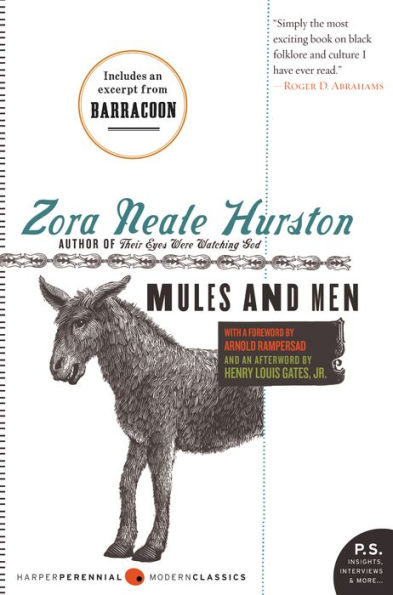
Book review: Mules and Men by Zora Neale Hurston

Zora Neale Hurston brings us Black America’s folklore as only she can, putting the oral history on the written page with grace and understanding. This new edition of Mules and Men features a new cover and a P.S. section which includes insights, interviews, and more.

For the student of cultural history, Mules and Men is a treasury of Black America’s folklore as collected by Zora Neale Hurston, the storyteller and anthropologist who grew up hearing the songs and sermons, sayings and tall tales that have formed and oral history of the South since the time of slavery. Set intimately within the social context of Black life, the stories, “big old lies,” songs, voodoo customs, and superstitions recorded in these pages capture the imagination and bring back to life the humor and wisdom that is the unique heritage of Black Americans. 

I had downloaded Mules and Men by Zora Neale Hurston last year when Barnes & Noble decided to drop a staggering amount of legit, popular free ebooks. I loved Hurston's writing in Their Eyes Were Watching God, and I'm always interested in folklore, so this was a no-brainer. I read this book for Black History Month, reading it slowly during my family's Mexico trip.

I was sort of expecting a straightforward telling of the folklore tales, like in Cuentos: Tales from the Hispanic Southwest, but the book is actually Hurston's account of her sponsored travels to Florida and Louisiana to collect the folklore and hoodoo knowledge. She relates how she goes back home (she'd been up north for college) to her hometown and then other Florida cities' African American communities, and the parties and get-togethers where the tales and 'lies' are told and songs are sung. I do think keeping the conversations and activity details was a good idea, as it keeps the context the stories were told in. The tone is narrative and casual rather than scholarly, as one might expect from a work of anthropology. There are footnotes for many (not all) of the slang and dialect terms and names, and glossaries in the back; it was very tedious to tap on the hypertext footnote numbers (I usually had to blow up the text size) and then tap back. This is the ebook formatting's fault, though, obviously. 

The folklore tales include stories of how things came to be (e.g. why cats and dogs don't get along), stories from slavery times, and more mythological stories involving God, the devil, angels, etc. Many stories are about an everyman named John who often outsmarts the slavemaster or the devil, but not always. The overall vibe is that these stories aren't true, but they're entertaining (even when things don't end happily for the characters). 'Lies' are things like, "I heard about land so fertile that when the farmer buried a dead donkey, a new one grew up out of the ground." These are often told by different people in quick succession on the same theme, to one-up each other and make everyone laugh. 

The speech is written in dialect, which is a bit difficult to read. How much you'll understand depends on what you know, as, as I mentioned, not all of the slang and dialect terms are translated in footnotes. It took me a second to realize that 'pail' in a food context meant a lunchpail, i.e., the lunch you pack to take to work or school. The term jookhouse* is never explained to my satisfaction; it's maybe like a brothel and a party house where jazz is played and dances are held all at once. The ballad of John Henry is given in full in the back of the book, but not the children's play songs. Sometimes historians omit things because they think they're common knowledge, and then future readers/scholars don't know what they are. :/

Hurston then goes to Louisiana to study hoodoo (also known, incorrectly, as voodoo) practices. She is initiated by and becomes an acolyte to at least three different hoodoo practitioners. This part took me longer to read because it freaked me out and I didn't want to read it at night (I'm a wuss when it comes to scary stuff). Besides being scared, I didn't like this part so much because some of the hoodoo practices involved killing animals in what felt like cruel ways (boiling or burying a cat alive, etc.). I thought it was kind of odd that Hurston begs her friends not to kill a venomous snake they find sleeping in her room when she's in Florida, sparing its life, but she's fine with the hoodoo animal sacrifices when those animals weren't a danger to anyone. There are lists of hoodoo practices and tools/ingredients in the back of the book. The ceremonies she observes and participates in are shared in detail, which I think is rather irresponsible (one is to bring about someone's death). Did the hoodoo practitioners, and their customers, know Hurston was going to write and share all of what they did and how they did it? Hurston says that hoodoo's whole thing is secrecy, then she shares all the secrets she learns. Ah well. 

Overall, this was a very interesting book. Hurston is an engaging and talented writer, and I enjoyed reading about her experiences. 

Score: ★★★.75 out of 5 stars (StoryGraph has opened my mind to the concept of quarter stars)
Read in: February 8-16
From: Barnes & Noble Nook

Genres/classification: nonfiction, folklore, fables, travelogue

Representation: African American/Black, poor, Southeastern American; Black female author

Trigger warnings: racism, slavery, beatings mentions, animal murder, animal cruelty, frequent period-typical N-word usage, sexism/misogynoir, violence, guns I think, alcohol

*had a sudden lightbulb moment and realized that this probably has the same root word as jukebox! See the Wikipedia entry's second paragraph. 

Wednesday, June 15, 2016

Hispanic Disney Princess, part 2

Here we go again.

Princess Elena of Avalor, a confident and compassionate teenager in an enchanted fairytale kingdom inspired by diverse Latin cultures and folklore, will be introduced in a special episode of Disney Junior’s hit series Sofia the First beginning production now for a 2016 premiere. That exciting story arc will usher in the 2016 launch of the animated series Elena of Avalor, a production of Disney Television Animation.
Remember my hit* post about Princess Sofia? I got all excited for a second that we were going to have a real Latina Disney Princess, but it turns out it's just a spinoff of Sofia the First on the Disney Channel. Elena does look 'more Latina', which yay for representation for brown girls (especially brown Latina girls), but you can't claim she's Latina since she's from a made-up country. Please read that post I wrote about Sofia for all my thoughts about giving us "Latin@" characters who are from a made-up world.
I am further annoyed by the "this fake world is inspired by Latino and Hispanic cultures around the world!" nonsense that I hate. Latin@s are not all the same; please don't lump us together. A ~*Latin-flavored*~ setting (when done by white people) is just insulting; there's better representation on a tortilla chip bag. I get that the amount of countries and cultures is overwhelming, but try to do better by us.
Although I guess you could argue that like half the white Disney Princesses are from made-up lands (Atlantis or whatever the mermaid city is called, wherever Frozen is set, etc.). So I guess what I'm annoyed by the most about this is that it's more of the same. They already did this to us with Sofia. Why aren't Latina princesses good enough to get a feature film? This feels like some "all animals are equal, but some animals are more equal than others" nonsense.

p.s. I am so excited for Moana!! PLEASE GO SEE MOANA; it needs to be super successful so that Disney will keep making movies about non-white people!


*not really

Thursday, October 18, 2012

Disney's First Hispanic/Latina Princess?

All right, finally found something to blog about! I have no idea how I missed reading about this earlier, but apparently Disney is going to have its first Latina princess. Her name is Sofia and she becomes a princess because her mom marries the king of Enchancia (yeah, I know). Read this article and this one too. What I find weird is this:
  • while Sofia's mom is clearly Latina (she is voiced by Sara Ramirez from Grey's Anatomy, while Modern Family's Ariel Winter voices Sofia) and has dark brown hair and eyes and brown/tan skin, Sofia has auburn hair, blue eyes and basically just looks white, and
  • Sofia is going to be in a computer animated Disney Juniors television show, not in a full-length feature film like any of the other Disney Princesses.
Being Latin@ is an ethnicity, not a race, so obviously there is a great deal of physical variation among Latin@s or Hispanics (Latin@ [the @ is used as a combination 'o' and 'a' symbol; in Spanish males' words end in o and females' words end in a, so this way both genders are included] is a newer term that roughly means the same thing as Hispanic, but the latter is a word applied to our ethnic group by the US government [aka white people] to classify us, so many Latin@s prefer this word. It's roughly the same to me, although I grew up using Hispanic because my parents do). I myself am a 'white' Latina; my dad is Mexican and my mom is of Cuban descent, but there is so much Spanish blood (my dad's family were land owners and he had a French whoknowshowmany-great-grandfather, while my mom's family are Cubans who also pretty much directly descended from Spaniards) that my immediate family pretty much all pass for white (my sister is blond, even). You don't have to dig very far in this blog to find pictures of me; I do have dark brown hair but I also have white skin and blue eyes. I'm whiter than most white people. Obviously, just because someone has light skin, hair and eyes does not mean they can't be Latin@.
The problem is that this is Disney's first Latina princess. This is a big deal. I think this is just about the only ethnic group the Disney movies haven't covered. Quick rundown of Disney Princesses: Snow White (come on. It's in the name/fairy tale), Cinderella (blonde/blue-eyed), Aurora (ditto), Ariel (first redhead! still white even though she is a mermaid), Belle (brunette and brown-eyed, French), Jasmine (first non-white princess! Arabian? Clearly Middle-Eastern. Agrabah is not I think a real place), Pocahontas (Native American, an actual person but she was so not like that), Mulan (Chinese, what I said about Pocahontas although technically she is not a princess since her dude wasn't a prince), Tiana (first Black princess! also from a real place, New Orleans, and is African American), and Rapunzel (after all that diversity I guess we needed to return to a blonde, white princess. She has green eyes, though). Oh, and Pixar's Merida (Scottish; red, crazy curly hair; blue eyes. Love her). These are the official Disney Princesses™, although Giselle (played by strawberry blonde Amy Adams), Kida (Atlantean princess with tan/brown skin, white hair and blue eyes who is all *~exotic~*), Ariel's daughter Melody (also white and has black hair like her dad Prince Eric), and Eilonwy (princess from The Black Cauldron. She's your basic blonde/white/blue-eyed princess but in her defense TBC is based on a book that was heavily influenced by your typical European fairytales) also exist. There has been no Latina princess, though, so it's rather disappointing that this one looks like your basic white girl. Yes, white-looking Latina girls like me exist (obviously), but we already have enough princesses to look up to or hold up as being or looking like me (Belle 4eva). What about the brown-skinned girls? There's just Pocahontas, Jasmine and Tiana for them, but none of these are Latina.
I think it's been a long enough time since the only two Hispanic-adjacent movies in this vein that we can do another movie set in pre-Columbus America about Mesoamerican peoples. The Road to El Dorado (which was made by DreamWorks but was clearly trying to mimic Disney's movies/success) was about two bumbling conquistadores trying to find/steal from a city of gold with a wily Mayan babe's help (can't remember if she's royal but I doubt it), while The Emperor's New Groove (set loosely in the Incan empire in Peru) does not have Emperor Kuzco actually get married (his wife would be an empress, though) since it is an odd-couple buddy movie. Despite Tumblr's lovingly referring to Kuzco as the best Disney princess, he does not actually count (although he is entertaining). It would be really neat to have an Aztec or Mayan princess, but it would be just as neat to have a standard princess with the dress and tiara and everything who just happened to have brown skin and dark hair/eyes. The Disney representative mentioned as the source of this information in one of the articles linked to above said that they're not flouting her ethnic background, just treating it matter-of-factly, which I think is fine. It would be nice if a brown-skinned princess were treated as normal.
This is especially a bummer since Sofia's show is set in Enchancia (ugh), a made-up country. The people there could look like anything you want (although at least it does seem rather diverse, judging from the trailer), and you have that girl and the ruling family looking white? Disappointing. I'm definitely not saying I want a sombrero-wearing stereotype or a story you can't watch without 'Cielito Lindo' constantly being played (I'm looking at you, From Prada to Nada), but why would you say a character, especially one you're trying to market as a Disney Princess, is Latina but then not have their culture be anything relevant? As the EW article says, "Sofia is half-Enchancian and half-Galdizian. The two kingdoms are in a world where a few real countries like France exist, but they’re still fictional, making words like Latina and Hispanic less clearly applicable." Some of the light-skinned Latin@s talking about Sofia on Facebook (link from the Mashable article) are angry that other people think she's too white, pointing out that skin color doesn't determine Latin@-ness (which is true) and that the white princesses and famous people don't share our culture and experiences. However, it's not like we light-skinned Latin@s are finally getting representation either; the child's from made-up lands. How does that count as Latin@? It doesn't, in my book. It feels like Disney's trying to seem diverse without really being so. Dora the Explorer's better than this. We're getting the short end of the stick, representation-wise.
I also think it's weird that Sofia is from a (pretty basic-sounding) TV show for young children. All of the 'real' Disney Princesses were at least in their teens, of marriageable (for their medieval/fantasy settings, anyway) age, and this one is clearly a little girl. This is Disney's first Latina princess, and she doesn't even get her own movie? That plus her age makes her not really count as a Disney Princess; it makes her not very important. I just barely heard about her today, and the show starts next month. Maybe they will do a real, brown-skinned Latina princess with her own movie in the future. Who knows. It feels like we still have a ways to go.
Image from Mashable. Note Sofia's mom, fourth little box from left.