Showing posts with label culture. Show all posts

Monday, May 8, 2023

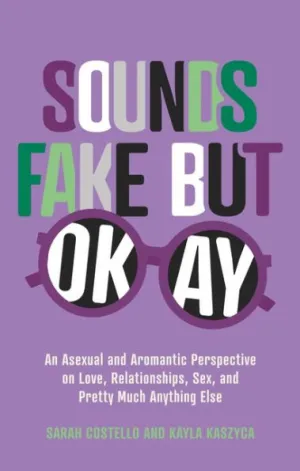
Book Review: Sounds Fake But Okay by Sarah Costello & Kayla Kaszyca

'Somehow, over time, we forgot that the rituals behind dating and sex were constructs made up by human beings and eventually, they became hard and fast rules that society imposed on us all.'

True Love. Third Wheels. Dick pics. 'Dying alone'. Who decided this was normal?

Sarah and Kayla invite you to put on your purple aspec glasses - and rethink everything you thought you knew about society, friendship, sex, romance and more.

Drawing on their personal stories, and those of aspec friends all over the world, prepare to explore your microlabels, investigate different models of partnership, delve into the intersection of gender norms and compulsory sexuality and reconsider the meaning of sex - when allosexual attraction is out of the equation.

Spanning the whole range of relationships we have in our lives - to family, friends, lovers, society, our gender, and ourselves, this book asks you to let your imagination roam, and think again what human connection really is. 

I bought this book during Barnes & Noble's 25% off preorders sale, and read it for International Asexuality Day. This book is based on an asexual- and aromantic-themed podcast from two best friends, which has the same title as the book. The title is a reference to people often thinking asexual and aromantic people are making stuff up. I am not a podcast person and had never heard of SFBO, but I might just seek it out. Each chapter tackles a different topic through the lens of the asexual and aromantic spectrums: society, yourself, friendship, romance and partners, sex, family, and gender. There is a glossary of terms in the beginning of the book, which is very helpful. Some stuff was known to me and some stuff wasn't; it's not so much that I learned from this book but that a lot was affirmed for me. It's nice to spend time in a book with such a solidly a-spec point of view. I wouldn't consider this a beginner, intro to asexuality/aromanticism type of book, but would be fine to read in conjunction with such books. It's not particularly advanced either. I liked how the book included podcast listeners' experiences and perspectives, instead of just the two authors'. Sarah identifies as asexual and aromantic, and Kayla as demisexual and biromantic; both women are white and cisgender. This is a worthy addition to the pantheon of asexual and aromantic books, and I would read it in addition to other books such as Refusing Compulsory Sexuality, which is from a Black asexual lens. This was a quick read and I recommend it.

Score: 4 out of 5 stars
Read in: April 7
From: Barnes & Noble
Status: keeping

Representation: asexual and aromantic, other terms and micro-terms under those umbrellas (demisexual, demiromantic, etc.), biromantic author, other LGBTQ+ identities from submitters

Cover notes: Love it, obvs. Not sure why the sunglasses are there but they're cute. Maybe as a reference to the Deal With It meme? Oh wait the "put on your purple aspec glasses" reference in the summary.

Trigger warnings: aphobia, acephobia, homophobia, references to sexual assault and harassment, amatonormativity, allocentrism, heteronormativity, sex and hookups mentions, vomit/ing mention, JK Rowling/Harry Potter mentions, that's all I remember

Tuesday, July 10, 2018

Book review: The Remains of the Day by Kazuo Ishiguro

I picked up The Remains of the Day by Kazuo Ishiguro because some blogger I read said it was good. It won the Man Booker Prize in 1989, and Mr. Ishiguro, who is Japanese-English, has won the Nobel Prize in literature. I thought it sounded interesting, and thought I'd give it a try. Here is the Amazon summary:

...Kazuo Ishiguro's profoundly compelling portrait of Stevens, the perfect butler, and of his fading, insular world in post-World War II England. Stevens, at the end of three decades of service at Darlington Hall, spending a day on a country drive, embarks as well on a journey through the past in an effort to reassure himself that he has served humanity by serving the "great gentleman," Lord Darlington. But lurking in his memory are doubts about the true nature of Lord Darlington's "greatness," and much graver doubts about the nature of his own life.
TRotD is very well written, and it's clear Mr. Ishiguro is a master of his craft. I thought the prose quite dense, however. Unless you've read a ton of 19th and 20th century British literature and/or are very familiar with the Downton Abbey or Jeeves and Wooster miniseries, a lot of this book will be hard to read and not make a lot of sense to you. You really need to have that early modern English class-obsessed culture and servitude knowledge.

[SPOILERS, I guess] One sub?plot of the book not touched upon in the Amazon blurb is Stevens' relationship with Miss Kenton, the housekeeper. The butler and housekeeper were the heads of the service staff, and as such generally had a closer working and possibly friendly relationship. While Stevens is the narrator and we see everything through his uptight and uber-professional viewpoint, it's clear that Miss Kenton has a crush on Stevens, what with bringing him flowers "to cheer up his room" and arguing with him in a flouncy Austen-heroine manner. Nothing happens between them as Stevens is so emotionally constipated because he thinks that's what a butler should be like, to the extent that he's too afraid of neglecting his duties to properly say goodbye to his dying father. Miss Kenton got engaged in an attempt to awaken jealousy in Stevens, and when it didn't work, she married the dude anyway even though she didn't love him. Stevens and Mrs. Benn meet up many years later and reminisce about the past. Stevens made the trip in hopes that she'll leave her husband (since she sounded unhappy in her letters to him) and they can work together again at Darlington Hall. However, this doesn't happen, making disappointment one of the major themes of the book (besides emotional constipation and love of class separateness). In one of the saddest lines of the book, Stevens says that he gave so much of himself to Lord Darlington that he doesn't think he has anything more to give to his current employer, a rich American Anglophile. [end spoilers]

Plot-wise, most of the action is emotional and philosophical. Nothing much really happens, so this book is recommended only for people who care more about feelings and history than action. This book was really sad but worth reading, probably. If it sounds like you'll be into it, give it a try.

The cover art above is really for the movie, which starred Anthony Hopkins and Emma Thompson. My copy had the same cover as a movie tie-in. Most of the covers for TRotD seem to have clocks, sundials, and hourglasses, due to the theme of time lost/gone by. A lot of covers have old fancy cars and show parts of headless butlers standing at attention.

Score: 3.9 out of 5 stars
Read in: mid May
From: the library booksale
Format: paperback
Status: giving away

Wednesday, October 11, 2017

July-September 2017 books

I didn’t read very much at all these last 3 months. I was just super busy and worked throughout the summer.

The first book I started in June was The Moor, a Sherlock Holmes book by Laurie R. King where he and his wife, Mary Russell, solve a mystery in the moor. I know, right? I totally thought this was going to be derivative fanfiction and that Mary was going to be a Mary Sue (pun unintended). This book was actually really good, very well written, and it did not trample on the Sherlock Holmes legacy. Mary is this badass Jewish feminist scholar and she wears trousers and keeps her last name in the 1920s! She takes over the Watson role, helping Sherlock and being the narrator of the novel. The only thing I didn’t like was that the ending was pretty abrupt. I actually want to read the rest of the series. 4/5

After that was Highland Fling, a historical romance novel by Amanda Scott that had more history than romance. The romance was pretty uneven and typical (headstrong redhead and this older rich dude who resists his attraction to her then is like ‘I’m going to tame you’, gag me with a spoon), but the historical stuff was interesting. England’s dickishness in taking over other countries is well known, but I hadn’t heard much about how it was for Scotland. Anyway this was ok and whiled away the time. 3.5/5

I decided to start reading books from my ever-growing to-read list, and checked out All the Single Ladies: unmarried women and the rise of an independent nation by Rebecca Traister from my library. This book did not disappoint: it talked about the views and roles of single women (mostly in the US) and the changes they’ve made in this country and culture. It was so good and affirming to read about all the kickass ladies out there who didn’t get married and had good, fulfilling lives, as well as women who today are dealing with various aspects of being single. I liked that Traister followed up with the women she interviewed for the book so that we could see where they were a few years later at the time of publication. The author is currently married with kids but was single well into her late twenties, so she gets it. I may buy this book for my own library. 4/5

The last book of this trimester is Morality for Beautiful Girls, the third book of The No. 1 Ladies’ Detective Agency by Alexander McCall Smith. He is British, and I am usually very suspicious of books set in countries the author is not from, and of books with characters of color when the author is white, but Wikipedia says he was born in Zimbabwe and worked in Botswana as an adult, so it appears he knows his stuff. The books (I’ve read another book in this series many years ago) sound like he’s done his research, and have colloquisms and the like. Mma Precious Ramotswe runs a detective agency with her assistant Mma Grace Makutsi and is called upon to solve all sorts of mysteries. In just this book MFBG, the duo must (together and/or separately) determine if a government man’s brother is being poisoned by his wife, figure out where a feral child found in the bush came from, run the detective agency and Mma Ramotswe’s fiance’s auto repair shop simultaneously, try to figure out why the fiance, Mr. J.L.B. Matekoni, is acting the way he is, and detect if any of the contestants of a local beauty and morality contest are, in fact, immoral. This is a lot of plots going on, but McCall Smith handles them all well. The characters are very well written, interesting and likeable. I want to read the rest of the series but since there are like 17, I’ll stick to getting them from the library. 4.4/5

Tuesday, April 4, 2017

January 2017 books

The first book I read and finished this year was Debating Disney: Pedagogical Perspectives on Commercial Cinema, which was a series of essays about Disney films under different lens (feminism, race, gay or Semitic stereotyping, etc.) It was interesting but somewhat dry as it is an academic work, but I would recommend it if you like analyzing Disney movies and can stomach reading academia. In my notes I had put that some facts were incorrect, but I didn’t put what so now I don’t remember. This was a library book. I may have skimmed this a bit, rather than reading every essay (early January, 3.9/5 stars)

I actually read a lot of library books since mine were packed up in boxes until a few weeks ago. The next one I read was In the Open Hand: Sonnets from the Californian, which is a book of poetry by a faculty member at the university where I work. It was pretty good but the reading experience was marred somewhat by the fact that I met him and it’s kind of awkward reading love poems by someone you’ve personally met. Not his fault; the writing style was quite good. (early January, 3.5/5 stars)

C.S. Lewis's Mere Christianity: A Biography is exactly that: the biography of a book. How meta is that? It went over the circumstances leading up to Mere Christianity being written, such as WWII and C.S. Lewis’s radio talks, as well as its reception and influence. This would be a great resource for someone wanting to write a book report on MC, or any other CSL megafan. I think I kinda skimmed this one towards the end as it is scholarly and dry. (mid-January, 4/5)

Later that month I went to my achilles’ heel, the thrift store, and bought several more books. Among them was a TV spinoff book, The Douche Journals, Volume 1: The Definitive Account of One Man's Genius. Basically the book is written as if it’s Schmidt from New Girl’s journal where he writes down every “clever” thing that caused him to be made to put money in the douchebag jar. It was just as crude and hilarious as I expected. (mid-January, 3.4/5)

I also acquired The Code of the Woosters at the thrift store, to my delight. These are laugh-out-loud funny, and I’m going to try to buy them all. I had seen parts of it from a BBC Jeeves and Wooster episode, but it was still hilarious.(mid-January, 4/5)

Also from the thrift store came The Mysterious Affair at Styles, my first Agatha Christie. I liked Hercule Poirot and the mystery was quite interesting, but I pretty much hated the narrator. He kept falling in love with every attractive woman and girl he saw, regardless of whether they were married or appropriate for him to date, then pouted when they didn’t like him back. His thoughts about the women were unnecessary and detracted from the story. I would have liked to know more of Poirot rather than that bimbo. I did like the story, but I won’t be keeping this one. (mid-January, 3.5/5)

Continuing my Artemis Fowl series reread, I read the fourth book, The Opal Deception. This one may have the most suspenseful plot of the series, and it pretty much held up reread-wise. (mid-January, 4/5)

My next library read was Youth and Sexuality in the Twentieth Century United States, which is a well-researched yet readable scholarly work. It was very interesting and showed that adolescence wasn’t as squeaky clean in the past as your grandparents would have you think (premarital sex was pretty common, for instance). The most interesting thing I learned was that children under 15 or so were expected to not be interested in the opposite sex at all, but in the same sex! Same-sex crushes were completely expected and seen as normal in older children and young teens. (lateish January, 4/5)

I was going to do a trimester-type post of my Jan-Mar books, but since I read so much in January, this is just for that month. That's why this post is so late.

Wednesday, October 14, 2015

Science Fiction & Fantasy class essays: H.G. Wells

Science as the Enabler of Evil
It is interesting to read the stories from when science was new and unknown. These authors during the early modern era seem to have seen science as a marvel, a new magic, something fearful and fascinating. The level of new discoveries and scientific possibilities was the highest since the Enlightenment, and because it was so new it was feared due to uncertainty and unfamiliarity.
Since the dawn of time, stories have been filled with people who had some fatal flaw that brought about their destruction, but science and advanced knowledge drive the stakes higher. The bigger they are, the harder they fall. There is more to lose, and more evil to be wrought due to this increased knowledge.
In The Island of Doctor Moreau and The Invisible Man, as in Frankenstein and some of Hawthorne and Poe's stories, science is a medium by which men who wish to further their and the world's knowledge and make a difference end up becoming obsessed. This obsession corrupts them and leads to their downfall, and they end up unleashing some new horror into the world instead of improving it. Science is then seen as a medium by which man's hubris may more fantastically, horribly and more speedily lead to their ruination.
We saw this first from Shelley's Frankenstein, but Wells especially seems to suggest that science can do away with our empathy and compassion. Dr. Moreau cares only for the advancement of knowledge that his vivisection experiments bring him; he doesn't care one whit about the pain he inflicts upon the poor animals and the ethical questions raised by his experiments. Likewise, Gibson's invisibility from his experiments gives him an advantage over others, and thus he becomes more and more violent and selfish as his story goes on. Wells et al. seem to suggest that science accelerates our natural selfishness and willingness to hurt others.


I don't think I mentioned this before, but these class essays were written in one go the night before the due date (as I'm sure you can tell). They could have benefited from some editing and reflection, but self-editing has never been my strong point and I was always too tired from work. After uploading her or his essay to Coursera, each student then had to grade three or four other students' essays. I had the harshest criticism of probably my entire academic career from this essay. One of the students who graded my essay hated it, reviled my writing and actually accused me of not having done ANY of the readings for the class. It was like the written equivalent of Donald Duck's tantrums. It was so irate and over the top that I went straight past hurt and offended and landed squarely on amused. Coursera lamely won't let me see anything I've done in that class since it ended, otherwise I would share the original feedback with you. 

Monday, December 23, 2013

Ballroom dancing and male-dominated society

I took several dance classes when I went to UCLA, partly because I have always wanted to learn and partly so that I would do some exercise during the week and not turn entirely into Jabba the Hut. The class was once a week, and I bought black and white loafers at my favorite cheap shoe place on Westwood Boulevard since tennis shoes were strictly forbidden and I knew I'd get blisters if I wore heels (and I'm tall enough as it is anyway). I took East Coast Swing the first semester (Winter '11), Ballroom basics the next 2 semesters (Spring and Fall '12), then Beginning Salsa (Winter '12), then Intermediate Salsa (Spring '12). The same instructor taught all the dance classes, a petite yet tough lady named Jackie. I loved it. I got to be pretty good, too (by which I mean you probably wouldn't die of secondhand embarrassment while watching).

I learned a lot from these classes: how to dance, obviously; how to follow; what to do in different circumstances. It was while dancing in one of the Ballroom dance classes that I realized how the culture of ballroom dancing directly parallels a male-dominated society like ours, especially the way it was in the past (which obviously makes sense considering the former arose from the latter). In ballroom dancing, the man leads. The man makes all the decisions, and the woman has to follow and go along with whatever he wants to do. If he wants to twirl her, she twirls. It's his decision. If she wants to twirl, she has to wait until it occurs to him. If she doesn't want to twirl, she's kinda out of luck unless she's willing to speak up ("hey, I'm getting kind of dizzy"). He moves her where he wants to go. He is supposed to have a firm hold on her. The firmer the hold, the better/stronger the lead.

The man always walks or moves forward, while the woman moves backwards. She can't see where she's going; the man decides where they're headed. I had a guy I was dancing with ask me once, "Isn't it weird to be always walking backwards?" "No," I replied, "I'm used to it." And that's how it is, in a male-dominated culture like ours. You are used to things always being a certain way, with men always being in charge and making the decisions. You get used to being the one who has no say, who does whatever the other has her do, who follows, who doesn't make decisions. You get used to being controlled, to always having the short end of the stick, to this world not being for you.

Girls would dance together if there weren't enough guys or if they just wanted to dance together (this happened more often than guys dancing together, which only happened a couple times as a joke), but one had to take the man's part (the Lead) and one had to take the woman's part. The rigidity of the gender roles stayed in the couple, despite their both being the same gender. Men could dance with two women, but I never saw two men dancing with one woman (I never took tango; that may be A Thing there; idk). I guess that as long as you have a Lead it doesn't matter how many he's leading.

The culture of ballroom dancing doesn't really prepare you for the real world, either (at least my classes didn't). The instructor always decreed that the men had to ask the women to dance (men lead and make all the decisions, doncha know). We girls had to stand there and wait for guys to come up to us and ask us to dance; we couldn't go up to and ask them. The most we could do was make eye contact with a guy we wanted to dance with and smile encouragingly. I'll bet that's what it was like to date in the olden times. Interestingly, when I went swing dancing with some friends at a local dance studio, I was ill-prepared for it because I just sat there and waited for guys to ask me to dance, which generally didn't happen. Hardly anyone asked me to dance because I was new and didn't know anyone, and on top of that and being really shy, I didn't ask anyone to dance because it felt wrong, like I was breaking the rules. My instructor had hammered it into my head that The Men Do The Asking. This did not apply in the real world (my friends asked guys all the time), and it left me sitting on the sidelines, feeling awkward and longing to dance but unable to due to antiquated rules I had internalized. In this way, the rules I learned in my dance classes actually hindered me in real life.

I realize there is an interesting point to be made about my instructor being a woman and teaching us the very traditional-role-y ballroom dances. Women often internalize and then turn around to teach the next generation the very same rules that cage them, that put them as lesser. When my teacher taught us the moves, she'd generally take the man's part and show us what to do with a volunteer girl from the class. (She would also sometimes have a guy who was a good dancer lead her in order to show us what the ladies were supposed to do.) The instructor was the leader of our class, and women who are leaders often have to take on male qualities because in the traditional mindset, leader=male.

Also, in classes where the guys outnumbered the girls, there would be a mad rush to ask girls to dance in order to avoid being left without a partner (the instructor made sure those who hadn't danced previously got to dance the next time). It was amusing and kind of amazing to see guys run or jump up to one and breathlessly say "hiwouldyouliketodance". One felt almost powerful, at that point (and there is so little power for women in ballroom dancing). This also didn't really help prepare me for the real world because in the real world, guys were not falling over themselves to ask me to dance (or on a date, I guess is the real-world parallel).

There is something that was positive about the dance classes' rigidly enforced gender roles and rules. The instructor was adamant about men doing the leading and asking, but she was equally adamant about the men being responsible for the women they were dancing with. It was the men's responsibility to make sure they didn't steer their partners into other dancers, or step on their toes, or make them dizzy by twirling them too much, or dropping them during lifts, or dipping them into other people, or crash into others or the wall, etc. If anything of that sort happened, it was automatically the man's fault. Many times I'd step on a guy's toes accidentally and apologize (the ingrained rules of my primary culture were stronger than this one's), only to have him say, "No, that's my fault; I wasn't leading you correctly."

Our male-dominated culture has men leading all the time, but outside of feminist circles you will rarely hear the blame placed on them. Wars and crime and economic crises and poverty and so forth occur under the watch of or are done by the group in charge (generally white heterosexual men, especially those who are rich) but they are almost always blamed on other people or seen as things that Just Happen ("don't get raped" instead of "don't rape"). Sometimes the bad things are blamed on others, on those not in the Group In Power (the U.S.'s economic state after George W. Bush being blamed on Obama, or the 'deterioration of our society' being blamed on feminism or secularization). We still have the male bias and domination without at least having the sense of responsibility, of acknowledging that it's their fault because it happened on their watch, when they were in charge, because they were in charge (and they're almost always in charge). If you're going to be in charge, at least own up to how much responsibility you have.

Not that I want Chivalry To Come Back, or anything. Just everyone be good to one another. And realize that what you've been taught, and the society we live in, is often messed up. But even in that (despite that?), you can find beauty and joy. I really did love dancing. I think I'll start up again.
Monday, August 27, 2012

Rereading Mansfield Park

I think I hate Mrs. Norris more than I hate any other Austen character. Probably even more than idiot Lydia from P&P, because she's young and, while stupid, is indiscriminate with her stupidity and doesn't single anyone out like Mrs. Norris does. Good grief does she ever have it in for her niece. What did the poor girl ever do to her? I hate her so much. She just smashes her down at every opportunity. Why is she so eager to make her low? What good does it do anyone? At least Austen shows an improvement in her writing by giving Mrs. Norris some comeuppance. Sir Bertram overrides her and won't let Maria move back home after the latter runs away and lives in sin with Henry Crawford, ruining her reputation etc., so she and Mrs. Norris are forced to live in another country together. Austen is clear that while Maria is her aunt's darling, Maria doesn't love her back. So there's something, at least. That's not enough of a comeuppance, in my opinion, but at least it's a bit better than what passes for Lydia's (she has to live out the rest of her days with Wickham, who doesn't love her. But her family mainly still keeps in touch with her. Ugh.).
It's also easy to get frustrated with the characters in Mansfield Park, but not as much as I did with S&S. The intro was all like "oh readers hate Fanny because she is so virtuous" but I like her, probably because I am rather like her. However, she is so very retiring and, well, wimpy, and modern culture has taught us to despise people who don't stand up for themselves, plus she's so weak and gets headaches from cutting roses in the garden wtf. Look at her life, though. She's the second oldest of TEN children (those who are anti-birth control haven't read this book, I'll wager. I do want kids but I'd rather die than have more than four) and is sent away to live with relatives who are strangers to her when she is ten years old, and the only one who is nice to her is her cousin Edmund and everyone is super eager to show her how inferior she is and is always ignoring, scolding, or putting her down. So of course she's the way she is. She could easily be worse. She actually shows strength of character in being against the play even though she'd been taught to obey her relatives all her life and her opinion was never taken into account. She also refused Henry Crawford even though her entire family, even Edmund, lectured that she should accept him because she'd never get a better offer. They even brought out the big guns that had kept her in control all her life, gratitude and obedience, but Fanny stuck to what she knew was right. I like her for that. The English professor or whatever who wrote the intro in my B&N copy points out that Mary Crawford is more of an Austen heroine than Fanny is, because Mary is sparkling and witty and flirtily argues with her love interest etc. But she hates religion and doesn't care about propriety and is all about the exciting rather than what is right. So for that she is not a good match for Edmund, even though they love each other.
Edmund is the second nicest character in the book, but I still get frustrated with him. Mary is beautiful and charming, yes, but really his love so blinds him that he cannot see she's totally wrong for him. He's going to be a clergyman, for pete's sake. And then instead of sticking up for Fanny when she turns down Henry Crawford, even though she explains that he's never acted properly and was leading both the Bertram girls on like the dickhead player he is, he lectures her too about how wrong it is of her to reject him. WTF, Edmund. Just because he's your gf's brother doesn't make him perfect. I mean, Edmund knows Fanny best of anyone and he really thinks Henry's a good match for her, with his player ways that don't take propriety into account? Come on. Just seeing her distress should be enough to not pressure her to do something she doesn't want to do. What I really dislike him for is when both Betram girls run away with their paramours (Maria with Henry and Julia with Mr. Yates) and he brings Fanny home from visiting her immediate family, and he's all like "yeah, Fanny, it sucks that your only suitor who was in love with you totally dropped you and ran off scandalously with your married cousin to live in sin and so now you'll never marry him, but think of ME! My gf didn't really do anything wrong except for not being shocked enough at the immorality of her brother and my sister, therefore showing that she's totally wrong for me and for a clergyman's wife!" Yeah, ok. Selfish much? I guess what he's saying that is that it probably hurts Fanny less because she didn't love Henry, but he really loved Mary so it really hurts to see, without any of the prior love-blindness, that she doesn't care about morality and is totally wrong for him. Like, she's only mad that they got caught, not that they did it. Still, though. And I was less disgusted with it this time, but I still hate that Fanny is a second choice. She's loved Edmund half her life, basically, and it's not until after he sees finally that Mary is wrong for him and finishes nursing his broken heart that he sees, "exactly when it's proper and not a week before", that Fanny's great. How convenient, he sees her good qualities in a new light and falls in love with her, mainly because his prior love, whom he really loved, turned out to be a twerp and wrong for him. Where have I heard that before? Poor Fanny. She's just a second choice, like Colonel Brandon. She deserves to be loved first.
This book is really heavy on morality and propriety, which makes it less popular today. It's hard to see what's so immoral about young people putting on a play to amuse themselves. I can see the objections to the play itself, which is about a mistress and illegitimate child, etc., but as to the putting on of the play I don't really get the objections. Oh well. The morality and Fanny's meekness are probably why this book isn't as well loved as P&P or Emma, as well as its slowness and length. The whole "be virtuous/a good girl and you will be rewarded (often with a love of your own)" thing is very common in literature of this period and before, but MP is more modern in its portrayal of this old trope. The book is clear that you will be unpopular if you do the right thing, that you'll be outcast and that those who do or think wrong are much more attractive than you. Society doesn't censure it anymore. It's harder to be good now that the reward is less sure. I like it also for that reason.

Thursday, July 14, 2011

Adventists are the original hipsters.

Oh, we were vegetarian/vegan before that was trendy.
We knew smoking was bad for you before it was widespread medical knowledge. We knew it all along thanks to Sister White.
I grew up on Arthur Maxwell's children's stories. Oh, you've never heard of them? Non-Adventists usually haven't.
Jewelry/coffee drinking is too mainstream worldly.
POTLUCKS LOL AMIRITE. Yeah, it's an Adventist thing; you probably wouldn't understand.
My favorite food is wheat gluten/Ceder Lake products/Fri Chik/Special K casserole/etc. Mmmm, Roma. I'm totally craving carob chips right now!
We live longer than everyone else because of our awesome lifestyles. My grandma is 134 years old and still goes to church 3 times a week/volunteers everywhere/lifts weights/runs marathons.
Kellogg's has Adventist roots. That's right, breakfast exists because of us.
Round Communion wafers and wine are so mainstream. We have square crackers and grape juice.
What am I listening to? They're the Heritage Singers; you've probably never heard of them.
You're eating a bacon sandwich at McDonalds??? Bourgeois sheep BADVENTIST!!!
Going to church on Sunday is too mainstream. Saturday church-going is where it's at. Everyone else is wrong; we have the TRUTH.
We did that whole "JESUS IS COMING ON THE 22ND!!!!! Oh, psych, He didn't come after all... It's because we didn't count right/a spiritual judgment not visible to us here on earth happened instead!" first, before Harold Campbell and all those other posers.

What Seventh-day Adventists believe
Hipster definition from Urban Dictionary