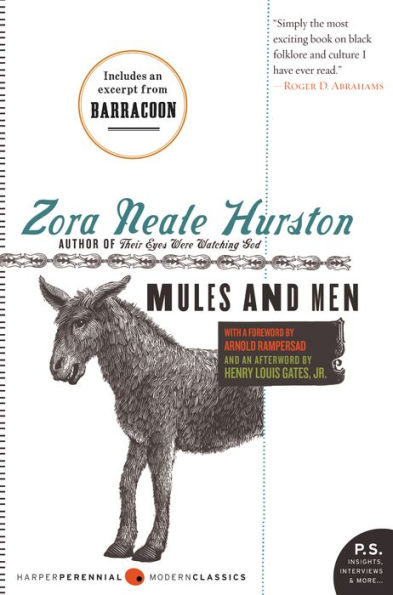
Zora Neale Hurston brings us Black America’s folklore as only she can, putting the oral history on the written page with grace and understanding. This new edition of Mules and Men features a new cover and a P.S. section which includes insights, interviews, and more.
For the student of cultural history, Mules and Men is a treasury of Black America’s folklore as collected by Zora Neale Hurston, the storyteller and anthropologist who grew up hearing the songs and sermons, sayings and tall tales that have formed and oral history of the South since the time of slavery. Set intimately within the social context of Black life, the stories, “big old lies,” songs, voodoo customs, and superstitions recorded in these pages capture the imagination and bring back to life the humor and wisdom that is the unique heritage of Black Americans.
I had downloaded Mules and Men by Zora Neale Hurston last year when Barnes & Noble decided to drop a staggering amount of legit, popular free ebooks. I loved Hurston's writing in Their Eyes Were Watching God, and I'm always interested in folklore, so this was a no-brainer. I read this book for Black History Month, reading it slowly during my family's Mexico trip.
I was sort of expecting a straightforward telling of the folklore tales, like in Cuentos: Tales from the Hispanic Southwest, but the book is actually Hurston's account of her sponsored travels to Florida and Louisiana to collect the folklore and hoodoo knowledge. She relates how she goes back home (she'd been up north for college) to her hometown and then other Florida cities' African American communities, and the parties and get-togethers where the tales and 'lies' are told and songs are sung. I do think keeping the conversations and activity details was a good idea, as it keeps the context the stories were told in. The tone is narrative and casual rather than scholarly, as one might expect from a work of anthropology. There are footnotes for many (not all) of the slang and dialect terms and names, and glossaries in the back; it was very tedious to tap on the hypertext footnote numbers (I usually had to blow up the text size) and then tap back. This is the ebook formatting's fault, though, obviously.
The folklore tales include stories of how things came to be (e.g. why cats and dogs don't get along), stories from slavery times, and more mythological stories involving God, the devil, angels, etc. Many stories are about an everyman named John who often outsmarts the slavemaster or the devil, but not always. The overall vibe is that these stories aren't true, but they're entertaining (even when things don't end happily for the characters). 'Lies' are things like, "I heard about land so fertile that when the farmer buried a dead donkey, a new one grew up out of the ground." These are often told by different people in quick succession on the same theme, to one-up each other and make everyone laugh.
The speech is written in dialect, which is a bit difficult to read. How much you'll understand depends on what you know, as, as I mentioned, not all of the slang and dialect terms are translated in footnotes. It took me a second to realize that 'pail' in a food context meant a lunchpail, i.e., the lunch you pack to take to work or school. The term jookhouse* is never explained to my satisfaction; it's maybe like a brothel and a party house where jazz is played and dances are held all at once. The ballad of John Henry is given in full in the back of the book, but not the children's play songs. Sometimes historians omit things because they think they're common knowledge, and then future readers/scholars don't know what they are. :/
Hurston then goes to Louisiana to study hoodoo (also known, incorrectly, as voodoo) practices. She is initiated by and becomes an acolyte to at least three different hoodoo practitioners. This part took me longer to read because it freaked me out and I didn't want to read it at night (I'm a wuss when it comes to scary stuff). Besides being scared, I didn't like this part so much because some of the hoodoo practices involved killing animals in what felt like cruel ways (boiling or burying a cat alive, etc.). I thought it was kind of odd that Hurston begs her friends not to kill a venomous snake they find sleeping in her room when she's in Florida, sparing its life, but she's fine with the hoodoo animal sacrifices when those animals weren't a danger to anyone. There are lists of hoodoo practices and tools/ingredients in the back of the book. The ceremonies she observes and participates in are shared in detail, which I think is rather irresponsible (one is to bring about someone's death). Did the hoodoo practitioners, and their customers, know Hurston was going to write and share all of what they did and how they did it? Hurston says that hoodoo's whole thing is secrecy, then she shares all the secrets she learns. Ah well.
Overall, this was a very interesting book. Hurston is an engaging and talented writer, and I enjoyed reading about her experiences.
Score: ★★★.75 out of 5 stars (StoryGraph has opened my mind to the concept of quarter stars)
Read in: February 8-16
From: Barnes & Noble Nook
Genres/classification: nonfiction, folklore, fables, travelogue
Representation: African American/Black, poor, Southeastern American; Black female author
Trigger warnings: racism, slavery, beatings mentions, animal murder, animal cruelty, frequent period-typical N-word usage, sexism/misogynoir, violence, guns I think, alcohol
*had a sudden lightbulb moment and realized that this probably has the same root word as jukebox! See the Wikipedia entry's second paragraph.