Showing posts with label mythological creatures. Show all posts

Friday, February 5, 2021

November and December books

 Yikes, I am so behind on my book blogging. 

cover of A Tale of Two Castles. a brunette girl faces and looks at the viewer while a dragon flies behind her. two castles are in the background.
A Tale of Two Castles is a book I had on my to read list for a while. I no longer remember where I bought it; I'm guessing I probably got it from Savers or another thrift store; Dollar Tree is another possibility. The book is by Gail Carson Levine, who was one of my favorite authors when I was younger, so I knew it would be good. Despite the title, the book is not a retelling of A Tale of Two Cities, but rather of Puss in Boots. It took me an embarrassingly long time to figure that out; probably halfway through the book at the earliest. The reason for that is because, instead of being told from the perspective of any of the characters in Puss in Boots, it's told from the perspective of an original character. Amazon summary:

Newly arrived in the town of Two Castles, Elodie unexpectedly becomes the assistant to a brilliant dragon named Meenore--and together, they begin to solve mysteries. 

Their most important case concerns the town’s shape-shifting ogre, Count Jonty Um, who believes someone is plotting against him. Elodie must disguise herself to discover the source of the threat amid a cast of characters that includes a greedy king, a giddy princess, and a handsome cat trainer.

Overall, I thought this book was very good and I enjoyed reading it. This book felt more grounded in its  medieval world than Levine's other fantasies have been, probably because she clearly researched life in the middle ages and peppered her book with factoids. For example, Elodie recounted having to bathe last all the time; her father would go first, then her mother, then their adult permanent guest, then Elodie because she's a child. The bath water, by the time she got to it, would be gray. As someone who is interested in medieval Europe, I very much enjoyed this book and most of its characters (Elodie was constantly talking back and interrupting her elders to the point of being annoying, and the only ahistorical thing is that none of them smacked her for it). I'd highly recommend this book to anyone who likes a fairytale retelling, particularly one of a fairytale that has not already been retold to death. Fans of Karen Cushman's medieval girl books will love this one as well. Amazon just told me that there is a sequel, and I absolutely am going to check it out. 4/5 stars, probably giving away. Trigger warnings for this book: attempted murder, poisonings, animal cruelty & possibly murder, imprisonment, descriptions of medieval European hygiene (humans having fleas etc.), speciesism and prejudice against fantastical creature/person, theft, can't think of any others.  Cover notes: I like everything on this cover except for the portrayal of Elodie. Elodie is a peasant who wore plain peasant garb; she would absolutely not be wearing such a fine dress. I don't like the pinched-looking face they gave her.


I reread Christmas with Anne and Other Holiday Stories by L.M. Montgomery, as is my custom each holiday season. 


I also read (or reread) a book called Politically Correct Holiday Stories by James Finn Garner. He's also written a couple of Politically Correct fairytale retellings. Basically he puts these famous stories through a politically correct lens, which changes them completely. It's difficult to say whether Garner is poking fun at the patriarchal, Christian-centric, sexist stories or at PC culture; it seems to be both. To give you an example, his Frosty the Snowpersun has the titular character start up a protest movement for snowpurson rights, and they eventually melt under the lights of the television studio where they are being interviewed. Rudolph the red-nosed reindeer (can't remember his politically correct moniker) formed a union with the reindeer so that Santa Claus would give them what they were due. Stuff like that. Relatively amusing, but I won't be keeping this one. 3/5 stars.  Cover notes: Santa & Mrs. Claus are looking out their window at a crowd of elf protesters holding picket signs that are decidedly pro-union and anti-Claus. Kind of funny but they deserve it. Trigger warnings for this book: inclusivity and political correctness mocked; depictions of misogyny, capitalism, sexism and speciesism; character death/melting. Can't think of any others.

Tuesday, December 10, 2019

Book review: The Saint of Dragons by Jason Hightman

Cover image for The Saint of Dragons, which shows a close-up of the top of a dragon's head.
This was a thrift store purchase from Savers. I picked it up because the premise sounded really interesting. Amazon/back of the book summary:

The ancient dragons -- of the time of the legendary Saint George and earlier -- have never disappeared entirely. Instead, they've moved undercover -- and into human society. Now one lonely schoolboy is about to learn where the dragons have gone ...
Educated at boarding schools, Simon St. George has never met his parents. When a ragged-looking man shows up claiming to be his father, Simon is skeptical, and when the man kidnaps him, he's indignant to say the least.
Then the man claims to be a descendant of England's Saint George and a career dragon fighter. Why should Simon believe any of this nonsense? But what if the man is telling the truth? What if the dragons know he's out there?
Rich with the dragon lore of legend, the saint of dragons continues and enlarges on the tale of the centuries-old conflict between dragons and humans that rages even today.

Neat, right? You know I love me some Chosen One/mythological creatures are still around stories. A lot of the elements from this book are very familiar: parentless boy at boarding school, picked on by classmates, dreams of something larger, learns of his fantastical lineage/destiny, etc. Overall I thought this book was good, if a bit done, but the writing was off somehow. Things went by too fast, and very little was fleshed out or explained in a satisfactory way. I was unsurprised when I read the author's note in the back, where he said he went to film school and wrote a screenplay about this book. It definitely reads like a movie, where we go from scene to scene and it's all very visually minded, but it lacks that true novel feel. We don't feel truly settled in the book or story; we're kind of just watching it whizz by.

Hightman definitely places plot and thrills over characterization; the characters feel like movie tropes in the way they interact with each other, and it doesn't feel real. I think Simon is the most fleshed-out character, but that's because we're seeing the book through his eyes. He makes a lot of stupid choices in the book that are incredibly annoying to read. Why don't characters in fantasy books read other fantasy books? I have to include this quote from one of the Amazon reviewers about this book because it's perfect: 
The plot reads like a series of short adventures and nothing seems very hard (including escaping from somewhere no one has ever escaped from). Like Rowling's books, there are plenty of inconsistencies with details only making sense for a specific scene and then being thrown out the window.  ~Joshua Koppel
There are a lot of cool inventions and world-building (as it were) things that we don't get explanations for. There are runes on the special dragon-fighting armor that enable the wearer to fly when touched! But how? What language are the runes in? How is the armor made? Most of the cool stuff is handwaved away with "a magician made it". There's also a prophecy that falls flat. Personally there are too many things jam-packed into this book.

The title is misleading and makes it sound like the St. Georges are the patron saints of dragons, rather than their sworn enemies. There's also a plot [SPOILERS] where dragons assimilated into human society by posing as them and are in charge of every political party in power/crime syndicate/big evil business/etc., which is way too close to the antisemitic lizards in charge of everything conspiracy (google it). I don't think this is what the author had in mind, as many people don't know the lizards conspiracy is about Jewish people, but still. The dragons were stereotypes of the countries they were from, especially the Chinese Black Dragon. I thought it was super weird that the black dragon was the only nice dragon, but the magic that emanated off of him was still dark magic that did bad things like make acid rain and conjoin people who walked next to each other on the street???? idk. I think dragons are cool and I wish more of them had been good. [END SPOILERS]

Anyway, this was entertaining enough and was a pleasant enough way to pass the time. Kids won't have the same complaints I do about the writing and pacing; in fact, it might be a good book to hand a kid who prefers movies to books. You could definitely do worse than this book, but if the things I mentioned drive you nuts, I wouldn't recommend it. If I come across the sequel, I'll read it.

trigger warnings I'd apply to this book: blood, gore, animal (ish) death, human death, magical violence, violence, fire

Score: 3.5 out of 5 stars
Read in: early December
From: thrift store
Format: paperback
Status: giving away 

Monday, August 13, 2018

Book review: The Book of the Dun Cow by Walter Wangerin Jr.

Spoilers throughout.

Walter Wangerin's profound fantasy concerns a time when the sun turned around the earth and the animals could speak, when Chauntecleer the Rooster ruled over a more or less peaceful kingdom. What the animals did not know was that they were the Keepers of Wyrm, monster of evil long imprisoned beneath the earth... and Wyrm, sub terra, was breaking free.

Animal books were one of my first loves. If there is any book about anthropomorphic animals that talk or fight battles reminiscent of Good vs. Evil, I am immediately sold. This one is probably the most obvious Christian not-an-allegory since The Chronicles of Narnia, what with the evil serpent and his offspring being successfully fought by faith, etc. 

What I was surprised to learn, however, is that TBotDC draws from the fable of Chanticleer and the Fox (the version found in "The Nun's Priest's Tale" from the Canterbury Tales) and the mythological basilisk. I have a book of Aesop's fables, so I'm sure I already read Chanticleer and the Fox, plus Chanticleer is an old name for a rooster that pops up in various older works. Chanticleer's wife is Pertelote, in both "The Nun's Priest's Tale" and this book. That's pretty much were the similarities end; there was a fox in TBotDC but he was friends with Chanticleer and his family. 

When it comes to the basilisk, however, everything I know about that mythological creature comes from Harry Potter. The main thing that sets the basilisk apart is the fact that it turns anything it looks at into stone, Medusa-like. However, this never happens in TBotDC. The basilisks in that book don't seem to have that power at all, otherwise the battle would have been over pretty quickly. The Encyclopedia Mythica says that the non-antiquity basilisk is part snake, part rooster, was hatched by a toad from the egg of a black rooster (Senex wasn't black, that I remember) and is also called cockatrice. This, in a nutshell, is the villain of TBotDC (apart from the Wyrm, but Cockatrice is clearly the Wyrm's son).
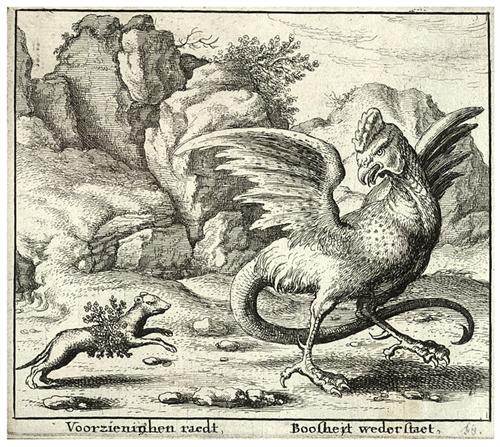
yikes dot net
See? I'm pretty well-versed in mythology and fairytales, and I'd never heard of this. Also, in this picture (found on the basilisk Wikipedia page) is a weasel covered in what looks like rue, the one plant basilisks would not touch. According to this fascinating article, the smell of a weasel was the only thing that could kill a basilisk, and weasels ate rue to make themselves imperious to basilisk venom. The weasel character is the most voracious and successful killer of basilisks in the book, and the animals all rub rue all over themselves in order to be able to fight the basilisks. Read all about rue and its historic uses here.

The Smithsonian article more closely matches Cockatrice's origin: "An aged cock, which had lost its virility, would sometimes lay a small, abnormal egg" to be hatched by a toad in a dunghill (I think Cockatrice's egg was hatched in the coop). The Wyrm persuades Senex to have his own son by laying an egg, aka turn his back on the natural order of things, like the snake in Genesis. The basilisk is also said to have a horrible smell that kills anything near it. In the book, Cockatrice's smell permeates the land, and while it doesn't kill anyone, it's horrible for everyone who lives there. 

Pliny the Elder echoes the end of TBotDC: "The animal is thrown into the hole of the basilisk, which is easily known from the soil around it being infected. The weasel destroys the basilisk by its odour, but dies itself in this struggle of nature against its own self." This is basically what happens, except instead of the weasel, it is the dog Mundi Canus who throws himself down into the pit to stab the Wyrm in the eye with a horn from the Dun Cow. Just as in the fable when Chanticleer gets the Fox to open his mouth and let him go by accident through pride, Mundi Canus gets the Wyrm to show his eye to be stabbed by taunting it into pride. I thought the dog  died from the struggle, but Amazon informed me that there are two more books in the series, and Mundi Canus comes back in the second book, which my library has! That makes sense; while TBotDC's ending was definitely a denouement, I felt like the evil had not been completely vanquished. 
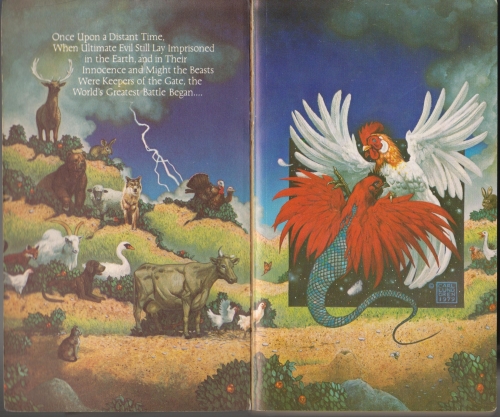
the inside front cover of TBotDC
On the Dun Cow: it seems to be only Chanticleer who sees her and has visions from her. I thought her to be a representation of God, but Wikipedia calls her "one of God's messengers", which would make her an angel. Just now I was reminded of another book, possibly one by Lloyd Alexander, where one of the protagonists goes to a Great Cow and is nourished back to health with its milk. There are cow deities, so lots of precedence for the Dun Cow. I don't think the Dun Cow showed up enough to warrant the book being named after her, though. 

There was a lot of sadness and horror in this book, but I really liked it. If you hate heavy-handed Christian allegories/parallels in fantasy fiction, this book is not for you. If you like books about anthropomorphic animals battling evil, mythological creatures and mythology, or Christian fantasy, I would definitely recommend this book.

Score: 4 out of 5 stars
Read in: end of July
From: the thrift store
Format: paperback
Status: keeping, but it's not a set in stone thing