Showing posts with label old books. Show all posts

Thursday, May 16, 2024

Antique book poem by Emily Dickinson

I was going to post a poem I came across while reading my old book of Emily Dickinson's poetry, but another Blogspot posted it and wrote (or shared) a commentary on the poem. I encourage you to read it here:

http://bloggingdickinson.blogspot.com/2014/12/a-precious-mouldering-pleasure-tis.html


Side note: I remember buying my copy of Emily Dickinson's poems from the Scholastic Book Fair when I was in elementary school, like I specifically have the distinct memory of being 7 or 8 or 9 at the Scholastic Book Fair and browsing the shelves, being drawn to Emily's face and picking the book up, but I just checked the copyright page and this is a small paperback from 2002. I was in the ninth grade in 2002; perhaps because I was homeschooled that year, I was able to go to my younger siblings' SBF and buy the book then? I have no memory of that, but I definitely would have gone then. I'd go today. I miss the SBF.

Wednesday, December 1, 2021

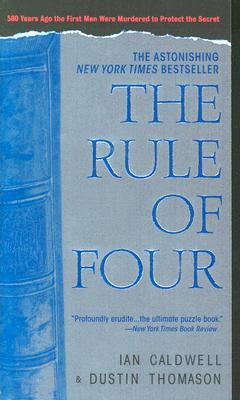
Book review: The Rule of Four by Ian Caldwell & Dustin Thomason

book cover of The Rule of Four. blue text on silver background, blue book spine to the left of text
The first book I read in November was The Rule of Four by Ian Caldwell and Dustin Thomason. It's a bibliomystery and is about two friends at Princeton trying to figure out the codes and secrets held in a mysterious Renaissance book, the Hypnerotomachia Poliphilli (which is real!). Murders start happening, and they start searching for clues for those too. They have to find all the answers before their dissertation is stolen or they're kicked out of Princeton. Read the official synopsis here.

The authors are two best friends who also both went to Princeton, so the setting felt real and lived in. The characters felt a bit stiff and formal, more like adults in their late twenties and early thirties than college students, but I was invested in them and their friendships. This may be because the book is set in 1999, but I don't think that would make the characters more mature. I liked the friendships between the four young men. I liked how Tom and Paul's friends helped with the riddles and clues; their med student friend helped with the medicine stuff, and Tom's girlfriend helped with riddles that had to do with her own major. The plot with the Tom and his girlfriend Katie was interesting enough, and she did feel mostly like a fleshed-out character, but I would have rather spent more time with the book. 

The HP incunabulum and its history was my favorite part, of course; there were so many things that I learned about in rare books classes (Aldus Manutius!) and things about Italian renaissance history, science and art (Florence! the Bonfire of the Vanities!).  The cryptology stuff was fascinating, with hidden messages encoded in the text which contained riddles, with the numerical code to the next riddle contained in each answer. The rule of four refers to the last numeric code needed to detect the book's hidden messages. One riddle had to do with who gave Moses his horns, which Paul did not get immediately. I call bull on this; everyone who tangentially knows anything about renaissance art and the Bible knows that Moses has horns in Michelangelo's statue of him because of a mistranslation (rays and horns being the same word). Paul, who knows Italian and Latin and basically everything there is to know about Renaissance Italy and its art, history, you name it, would have picked up on this right away. Paul says in the book that Michelangelo (or Jerome?) depicted Moses with horns because he felt only God should have glory radiating from His face, but I don't think that's true. 

The Hypnerotomachia Poliphilli wove its way through Tom and Paul's lives and the lives of Tom's father and his friends, who became Paul's advisors and mentors. The HP was a source of life-long obsession to these men, and it impacted their relationships with their partners and each other. Tom's father being obsessed with the HP damaged his relationship with his wife and son, while Tom's obsession with the HP strained his relationship with his girlfriend. Tom's father and his friends echoed Tom and his friends. This book deals with loss, obsession, academia, friendship, depression, relationships, and more. It was very sad but very fascinating. I loved the HP parts but I don't think I'll reread or keep this one. It stayed with me for a while. 

Score: 3.5 out of 5 stars
Read in: November 2-3
From: the thrift store?
Format: paperback
Status: giving away

Trigger warnings for this book: murder, death (various methods, some of them violent), car crash, blood, semi-graphic major injury, other injuries requiring hospital stays, alcohol overuse, obsession, depression, sex, mentioned nudity, sexism/misogyny, privileged Princeton pigs

Wednesday, February 26, 2014

TIFITLWIW: The Golden Treasury

This is one of the biggest, loveliest old books I've ever seen and held. It's The Golden Treasury of Poetry and Prose, edited by Francis F. Browne and with an introduction by Richard Henry Stoddard (1883). It's probably a foot wide, a bit longer than that long and about 3-4 inches thick. And it has wonderful illustrations/engravings. Here are the pictures I took of it:


The gold parts are metallic and shiny. 

These are the authors. I think the signatures are pictures of their handwriting rather than actual physical autographs. Also, Francis F. Browne can get it. I'm totally submitting him to My Daguerreotype Boyfriend.

                           BOOKS.
I cannot think the glorious world of mind,
Embalmed in books, which I can only see
In patches, though I read my moments blind
        Is to be lost to me.

I have a thought that, as we live elsewhere,
So will those dear creations of the brain;
That what I lose unread, I'll find, and there
        Take up my joy again.

O then the bliss of blisses, to be freed
From all the wants by which the world is driven,
With liberty, and endless time to read
        The libraries of Heaven!
~Robert Leighton

Thursday, September 26, 2013

September book haul

From an estate sale I went to a couple weeks ago:
-Agnes Grey by Anne Brontë (I read somewhere that fans of Jane Eyre would like this so I bought it)
-Laments For the Living by Dorothy Parker (I have her Enough Rope and adored it. This book is of short stories rather than poems but who cares)
-Sonnets From the Portuguese by Elizabeth Barrett Browning (I had bought a different copy for a friend for her birthday but apart from reading the few sonnets everybody knows I haven't read this myself)
-the aforementioned New York Public Library Desk Reference book, which I bought for and have at work

Oh I just remembered I had bought a book from an earlier estate sale as well. It's this 1800s book of Sir Walter Scott's collected poetical works, in leather. Not bookbinding leather, like straight up cowhide, with flowers painted on it. It's so old! I'm not a Scott fan (haven't read anything by him, although I have Ivanhoe waiting for me on my bookshelf) but it was so fragile and amazing I couldn't leave it behind. It has a picture and signature (probably also a picture, rather than physically signed) of the author inside, facing the title page, but the first like 8 pages are bug-eaten so I don't know which year it's from. Definitely from the 1800s, though.
I also bought from this estate sale the DVD of The Hitchhiker's Guide to the Galaxy, which I'd been wanting to watch for ages.

From my public library's year-round booksale:
-Thank You, Jeeves by P.G. Wodehouse (read this already. Cracked up throughout, like straight up bursting out laughing p. much every page. One word: BANJOLELE. I must read the others. Only qualms: blackface is a plot point! Not once but twice!! And the N-word is dropped casually, constantly, by every character except for Jeeves [perf human being and the best]. Oh 1930s, you so racist. :/)
-Codex by Lev Grossman (I just like grabbed it off the shelf because it was called codex and the cataloging notes said medievalists–fiction. I'm currently reading this. It's about this guy, an investment banker or something, who gets assigned to catalog and sort a rare books collection/library of some English aristocrats and also gets hooked on a virtual reality, quest videogame which I think is supposed to mirror his IRL search for a mythical codex in that library. It's very slow moving; we just see the guy sort and catalog books and then go home and play the videogame and sleep. I love it. I can sort and catalog books all day; apparently I can also read about people sorting and cataloging books all day too. It's just my speed, interesting and old books and not too high-stakes. Also there's a standoffish medievalist grad student who helps the guy and she is basically 10000% done with everything and only cares about the books and medieval/Renaissance/book history. I love her. I'm sorta hoping they become bros instead of ending up together but that's what will probly happen.)

I just bought The Fantastic Flying Books of Mr. Morris Lessmore by William Joyce, which is just as lovely as I remembered. Such a wonderful book. I had sorta forgotten about it until I saw the picture book at Barnes & Noble. It was, interestingly, a short animated film (which won an Oscar) first, then an app (which I did not know), and now a picture book. You'd think it'd be the other way around, ironically enough. Anyway, I found and read the book (gorgeous; they made it look like the one ML writes in!) but didn't buy it since picture books are hideously expensive. But lo and behold, I got a 20% off B&N coupon in my email and bought the book at a reduced price using the last of my giftcard money! Worth it.

Tuesday, June 11, 2013

TIFITLWIW: Title pages

A Book of Golden Deeds of All Times and All Lands, Gathered & Narrated by Charlotte M. Yonge (Dutton & Co., ~1908).
This book, which I think is about good deeds done by good people, sounds kinda didactic and boring. Aren't the title pages gorgeous though? I love the quote by Shakespeare. This is actually my current cellphone wallpaper.


Modern Essays Selected by Norman E. Brett-James (Dutton & Co., ~1924)
By the same publishing house. I didn't notice that until now. Gorgeous early twentieth-century books.


 Dante Alighieri's The Divine Comedy, translated by Lawrence Grant White with illustrations by Gustave Doré (Pantheon Books, 1948)
Totally nerded out when I found this. This gif is what my face was doing as I flipped through the book. Also, note Dante's uncanny resemblance to Grumpy Cat.

Paganism, Popery, & Christianity... by Vincent W. Milner (Bradley, 1860)
This one's not as pretty but I'm showing it as an example of the crazy-long titles books used to be given. They didn't mess around in those days; they wanted you to know exactly what was going to be in their book. Click and read this one; it's great. I am also amused by how RAGE OF THE PROTESTANT VARIETY the author is about Catholicism. It's easy to forget about that being A Thing in the 1800s. Let There Be Light is also the motto of UCLA; not sure why the circle/seal thing is a belt. Also, this book is older than the American Civil War.