Showing posts with label history. Show all posts

Wednesday, May 31, 2023

Book Review: Dragonwings by Laurence Yep

Moon Shadow only knows two things about his father, Windrider: he lives in San Francisco and used to craft beautiful kites. One day shortly after his eighth birthday, Cousin Hand Clap arrives with a letter from Windrider asking Moon Shadow to join him in San Francisco. When Moon Rider arrives in America he learns that his father makes a living doing laundry and dreams of building a flying machine just like the Wright Brothers. But making this fantastical dream a reality proves to be no easy task, as intolerance, poverty, and even an earthquake stand in their way.

Inspired by the story of a Chinese immigrant who created a flying machine in 1909, Dragonwings touches on the struggles and dreams of Chinese immigrants navigating opportunity and prejudice in San Francisco.

I think I was in the fourth grade when I first read Dragonwings, as that's when California public elementary schools teach California history, and I loved the book. I was captivated by the fantasy aspect of it, even though Windrider's dream is such a small part of the book, and I remember drawing the King of Dragons with lots of tiny detailed scales (complimented by my classmate as "cool"). The writing is simultaneously gorgeous and detailed as well as believable as a child's voice. I bought this library binding school edition of Dragonwings with complementary readings from a thrift store. 

As I read the book, I re-remembered parts of it that I hadn't thought of in years. The parts I remembered best were the dragon dream, the white lady and her granddaughter, their house's stained glass window of St. George fighting the dragon, and the plane's flight. It was like reconnecting with an elementary school friend you remembered well, but find they're different than you thought since it's been 25 years since you've seen them.

I hadn't remembered the extent of the hardship Moon Shadow and his family face; the first night he's in the Lee laundry house, Chinatown is hit by a window-smashing white mob. There's frank mentions of hate crimes against Chinese immigrants; Moon Shadow's own grandfather, who had moved to America to help build the railroads, was lynched. There's threats within the Chinese community as well: the rival gangs and Black Dog, a "cousin" who's addicted to opium and prone to theft and violence against his own people and family. Trouble with Black Dog's gang prompts Windrider and Moon Shadow to move out of Chinatown into a boarding house's garage, which brings them into contact with the kindly old landlady and her headstrong granddaughter. They all become friends and teach each other about their respective cultures.

Windrider becomes obsessed with creating a flying machine like the Wrights brothers' in order to live up to his previous life as a dragon. The characters all experience the San Francisco earthquake of 1906 and the subsequent fires, which were harrowing to read about. This book taught me more about the circumstances of Chinese immigrants in the early 20th century and what it was like to live through the devastating days during and after the earthquake than anything my textbook had. This is why historical fiction is so important; it helps children and adults experience the time and circumstances through the eyes of the characters, and cultivates empathy. It's radically important, and I'm glad Yep wrote this book.

To be honest, I mostly skimmed the related readings. One was a Ray Bradbury play of an Orientalist caricature emperor who executes a man who flies in a giant kite-inspired flying machine because the people must not be tempted to dream, or something. Typical Bradbury stuff. The depiction of the emperor is silly and stereotypical (he strikes a gong after every sentence he says), but I think Bradbury is making fun of the stereotypical & Orientalist way Chinese people are depicted in the early to mid-twentieth century. The poems were fine, and I skipped the "'The Chinese Must Go'" essay. There was an eyewitness essay about the San Fran earthquake that I also skimmed; I found it interesting that Jack London focused on the positives and made it sound like everyone only helped each other and no one did anything bad. I know Dragonwings is not an eyewitness account, but it's frank in depicting looters, including among the police and US military dispatched for public "safety". Unsurprisingly, the Chinese immigrants are forced out of the park where homeless survivors have been sent and dragged around San Francisco (not literally) due to racism and xenophobia. 

Overall, a sad yet very good book. An excellent read for Asian American Heritage Month. Do they still teach this book in elementary school? Let me know.

Score: 3.5 out of 5 stars
Read in: May 23
From: the thrift store
Status: selling

See my aesthetics moodboard for Dragonwings.

Representation: Chinese, immigrant, poor/lower class/low socioeconomic level characters who experience poverty/economic hardship, minor disabled character with 1 hand, minor/secondary elderly characters, opium addict is the violent antagonist, natural disasters survivors

Cover notes: The copy I read all those years ago had the exact same illustration of Moon Shadow and his father with the kite. This school copy is fine, although I don't like the yellow circle. I think mine had an image of the Newbery Honor Award the book won.

Trigger warnings: murder, lynching, hate crimes, death, racism, xenophobia, a child is beat unconscious by an adult, misogyny/violence against sex workers (off-page), buildings collapse during earthquake killing the people inside, secondary character cuts his own hand off with a cleaver, drug addiction, poverty, physical violence, racist bullying by older child, blood, child labor, people in shock due to earthquakes, hunger, sudden disaster-based homelessness, gambling addiction, theft

Sunday, October 9, 2022

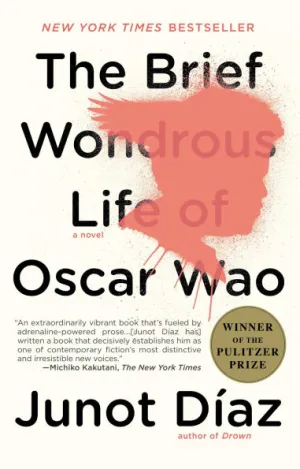
Book Review: The Brief Wondrous Life of Oscar Wao by Junot Diaz

Oscar is a sweet but disastrously overweight ghetto nerd who—from the New Jersey home he shares with his old world mother and rebellious sister—dreams of becoming the Dominican J.R.R. Tolkien and, most of all, finding love. But Oscar may never get what he wants. Blame the fukú—a curse that has haunted Oscar’s family for generations, following them on their epic journey from Santo Domingo to the USA. Encapsulating Dominican-American history, The Brief Wondrous Life of Oscar Wao opens our eyes to an astonishing vision of the contemporary American experience and explores the endless human capacity to persevere—and risk it all—in the name of love.

As you know, I'm reading solely Hispanic/Latine books for Hispanic Heritage Month. This one had been on my radar ever since it blew up in the late 2000s. I bought it from a thrift store a few years ago and I hadn't read it until now. The thing about non-children's (and even some children's) Latine books is that I know they're going to talk about sad and hard things, because the reason we're Latin America is because of colonization and all the hard things that entails. There isn't a single LatAm country that isn't still feeling the effect of colonization. Diaz realizes this, and the narrator realizes this, and so we are told not just Oscar's story, not just his family's story, but the Dominican Republic's story, including the long shadow of Trujillo. Oscar and his family's stories are impossible to tell apart from that. 

For this book ostensibly being about Oscar's life, we don't dwell on it much. Oscar grew up steeped in machismo and was a pint-size Casanova until he got his heart broken when he was 7. He discovered science fiction and fantasy soon afterward, and became the kind of geek who says "hail and well met" unironically to obviously non-geeky people. Oscar's weight gain, desperation, depression, low self esteem, not being able to see women as people, and heavy incel energy keep him from finding love or getting laid. Like the narrator, Oscar's roommate Yunior, you want to shake him by the shoulders. Snap out of it! It is difficult to understand an undateable person's despair and loneliness if you have not experienced it yourself. We are told nearly from the beginning that Oscar dies young. It is not from his suicide attempt, but being murdered after falling in love with a taken woman.

Oscar's sister Lola is a Dominican goth and the only daughter, which should give you a window into her suffering. Her mother is incredibly cruel to her, and she rebels by cutting out the criada stuff and then running away. She's the nicest to Oscar, and has a short thing with Yunior at one point. I felt for her, as hers was not an easy life. I know she's not real but I really want her to be happy. She ends up with a husband and kids, but we don't learn about them.

Beli is Oscar & Lola's mother, and her life is harder than her children's put together. Her family is assassinated by Trujillo's people for a minor reason, and she's basically a slave as a small child until her father's distant cousin adopts her and acts as her mother and as Lola & Oscar's grandmother. Beli becomes very attractive and curvaceous during puberty, incurring lots of male attention, including that of a married gangster she falls in love with. His wife has her beaten in the same cane fields her son will be beaten and killed in years later, but she's saved by a guardian spirit mongoose. She's sent to the US to escape, and meets her husband and has her children there. She gets breast cancer later, but outlives her son. She loves her children, but her hardships made her a hard person.

The writing in this book is superb, lyrical and slang-y and conversational. There's a lot of Spanglish and untranslated Spanish words, so I feel like you can't really get this book if you don't speak Spanish. There's probably stuff I didn't get because I'm not Dominican. This book has a lot of footnotes, especially in the beginning. I like footnotes so I don't mind this. There's constant N-word use, which seems to be part of Dominican American slang (used the way I use 'dude'). There's also mention of racism against Haitians (which is wild to me because they're both on the same fucking island. How are you going to hate your sibling-neighbors.). While it was difficult to read, this book was just so interesting and well-written that I couldn't put it down. I literally read it at work instead of working, which I never do. This book's Wikipedia page has a good breakdown of the themes, motifs and parallels in the stories. I learned a lot about Dominican history and the Trujillo regime, which I hadn't known much about.

I want to talk about the misogyny in this book. Obviously there's a ton of machismo in Latin American countries and culture (reminder: I am latina). Oscar gets tons of praise for being a womanizer in 2nd grade or whatever, and he has an inability to see women as whole people, putting them on a pedestal and getting disappointed when they don't fall in love with him even though he's there. I've mentioned the incel energy, although Oscar doesn't feel like he's owed sex or romance and doesn't hate women. He does have a tendency to stalk them and ignore boundaries. Just about every female character, no matter how glancingly mentioned, has her body and looks discussed in a very specific and objectifying way. Yunior is a cheating womanizer and definitely sees women as objects. He's very flippant about the fact that Trujillo raped whoever he wanted. Both he and Oscar are deeply influenced by the machismo of their culture and upbringing. There's also rape culture, sexual assault, and a lot of talk of very young girls dating (being groomed/statutory raped by) much older men. For example, Beli is 14 or 15 when she gets together with the middle-aged gangster. This was very difficult to read. Junot Diaz has been accused of past sexual assault and sexism. I considered not reading this book, but I felt that I might identify with Oscar (I kind of did). You'll have to make the decision to read this book yourself. 

Trigger warnings: rape and sexual assault, child abuse, murder, characters beaten to death, suicide attempt, grooming, domestic abuse, assassinations, police brutality, misogyny, objectification of women and girls, miscarriage mentions, racism, colorism, genocide mentions, stalking, explicit sex, sexism, slavery (including child slavery), domestic slavery, gun violence, alcohol abuse, whorephobia, infidelity

Score: 4 out of 5 stars
Read in: October 5
From: thrift store
Status: giving away/selling

Tuesday, March 22, 2022

Book Review: Broad Band: The Untold Story of the Women Who Made the Internet by Claire L. Evans

My brother, a software?* engineer, and sister-in-law bought me this book for my birthday, correctly guessing it would interest me. I was excited to receive it and then (all together now!) it sat on the shelf for several years. I decided to read it for Women's History Month. Summary below: 

The history of the internet is more than just alpha nerds, brogrammers, and male garage-to-riches billionaires. Female visionaries have always been at the vanguard of technology and innovation.

In fact, women turn up at the very beginning of every important wave in technology. They may have been hidden in plain sight, their inventions and contributions touching our lives in ways we don't even realize, but they have always been part of the story.

In a world where tech companies are still male-dominated and women are often dissuaded from STEM careers, Broad Band shines a much-needed light on the bright minds history forgot, from pioneering database poets, data wranglers, and hypertext dreamers to glass ceiling-shattering dot com-era entrepreneurs.

Get to know Ada Lovelace, who wove the first computer program in 1842, and Grace Hopper, the tenacious mathematician who democratized computing after World War II. Meet Elizabeth "Jake" Feinler, the one-woman Google who kept the earliest version of the Internet online, and Stacy Horn, the New York cyberpunk who ran one of the world's earliest social networks out of her New York City apartment in the 1980s.

Join the ranks of the pioneers who defied social convention to become leaders of the tech revolution. This electrifying corrective to tech history introduces us all to our long-overlooked tech mothers and grandmothers—showing us that if there's a "boy's club" that dominates Silicon Valley today, it's an anachronism.

The title is a pun - broadband and broad (early/mid-twentieth century slang for woman) band. A band of women gave us broadband. Sort of. They made the internet possible anyway. Claire L. Evans takes us through a brisk tour of of women's contributions to computer science and the World Wide Web/Internet (yes, those are two different things. No, I can't really explain it to you). She starts with Ada Lovelace and female computers (if you've seen Hidden Figures then you get it), going on to Grace Hopper and other awesome ladies programming and debugging computers etc. Then she goes on through the decades to talk about other awesome tech women, none of whom I had heard about. An English woman came up with working hypertext like a decade before Tim Berners-Lee did, but used a different format of internet. It's all such fascinating stuff. The internet makes perfect sense to me: stuff links to other stuff. But early tech and internet connections? Holy shit. How did they do that?!?!?

Evans covers all of this in an engaging way, neither too scientific or casual/chatty. As a journalist, Evans (who interviewed just about all of these women personally) is great at telling the stories, yet she doesn't tell us enough. I am dying to know more about these women, but there are hardly any pictures or a suggested reading list (I guess that's not necessary but always appreciated). Stuff I didn't need to know about (Grace Hopper's drinking problem) was shared while other stuff I did want to know (some of these women must have been queer, right?) was not. There are endnotes, but no little numbers in the body of the text to indicate which citation or quotation goes to which endnote (I guess we're supposed to count quoted sentences in each chapter?), which I personally think is irresponsible in a nonfiction book. 

Anyway, I really enjoyed this book and want to learn more about the awesome women who gave us the internet/WWW, allowing me share my stupid little book reviews that no one reads anyway. Thanks for everything, ladies. 

Score: 4 out of 5 stars
Read in: March 8-15
From: gift
Status: keep

Cover notes: I love the use of the motherboard (so punny) to make a lady figure, but I think the b00b parts are unnecessarily crass.

Trigger warnings for this book: sexism, institutional sexism, transphobia in the chapter about the 1980s social network, drug and alcohol use mentions, claustrophobic depictions of spelunking in caves

*my engineer brother does something on computers with coding that affects internet/app-seeming things. That is the best I can tell you. Software engineering sums it up as best as I understand it. It's all very tech-y.

Sunday, February 25, 2018

Book Review: The Lost Tomb by David Gibbons

The Lost Tomb is one of those archaeological/religious mysteries, a la The Da Vinci Code . It is about an archaeologist, Jack Howard, who makes all sorts of exciting discoveries in and around the Mediterranean Sea which lead him on a wild goose chase to London and Southern California etc. to find what might be the actual written words of Jesus Himself. Of course, a shadowy Roman Catholic organization will do anything to bring him down, including MURDER.

David Gibbons is a diver and has dived in the Mediterranean and made interesting finds, which lends ample credence to the parts of the book where Jack and Costos dive in the Mediterranean Sea and try to find stuff on the sea floor that belonged to Paul. It is also evident that he did his research. 

TLT is apparently the third book in the Jack Howard series. In the prior books Jack discovers Atlantis and the lost menorah from the Temple in Jerusalem, and the rest of the series seem to be about similar historical discoveries. Jack is the typical ruggedly handsome archaeologist who is also a dynamite deep sea diver and is very physically fit and fearless and knows about like every type of history, art and architecture. Very Gary Stu-ish. As a result he is not a very well-rounded character, although the book tries to make him interesting by giving him a like star-crossed former lover who maybe is killed because she tried warning him about the danger (signs point to her maybe surviving).

 The other characters in TLT are from his archaeological diving team and/or are contacts in the history/archeology etc. fields who help him out in his travails. I noticed that despite their being experts in their fields, at some point or another they have an oddly out of character blank in their knowledge, something even I know, which is clearly there so that Jack can swoop to the academic rescue and explain it for them and the reader. They also spend a lot of time explaining historical/archaeological facts to each other, which is clearly intended to inform the audience. This wasn't too annoying for me, because I like these topics, but it might annoy other readers. One character, Costas, got very grossed out when having to navigate around dead and rotting bodies (that had been dead for hundreds if not thousands of years), which would be accurate for a lot of people, but I felt like it was written in for comic relief and to showcase how stoic and brave Jack is. My favorite character was the Ethiopian nun who helped them get into the main cathedral in Jerusalem.

Despite the characterization flaws, The Lost Tomb is a very interesting story that pulls you in and makes you want to know what happens next. The flatness of the characters does not diminish the story; the discoveries and chases are the point. I liked the different settings in places I'd like to visit and the subject matter. Obviously, in a genre like this you have to compare the book, main character, and writing to Dan Brown's Da Vinci Code books. I read the latter in high school, so it's been quite a while, but I think David Gibbons' series comes out on top, mostly because it isn't trying to be more than what it is and isn't smugly patting itself on the back at every clever turn. Brown's series also uses sex and murder to be shocking, while Gibbons relies on the twists and turns to keep you reading. I will say that if memory serves, Brown's writing is better than Gibbons', with more character growth. It also has more intrigue, if you're into that. Both books obviously rely on unproven things being true in order to build on them and have more untrue things being true (because A, then B, therefore C, even though A has never been proven and is probably made up). For The Lost Tomb, it was assumed that the shipwreck the Apostle Paul went through when being taken prisoner to Rome happened off a different island than was mentioned in the Bible. 

The Lost Tomb also has the same assumption as The Da Vinci Code that because the Bible has had so many transcribers and translators, the original meaning was lost, and rapacious Christian leaders co-opted Jesus' words to their own means for both profit and power. This is untrue, since great care was taken in both the transcribing and translation of the texts, and it bugs me to hear educated people still parroting that sort of view. The issues within the Church are the same as the issues with humanity in general: we are imperfect and proud and like to be right, and this creates problems when there are large groups of us. No one who began the Christian Church ever set out to profit; they wanted to spread the good news. Also, obviously the Roman Catholic church has done a lot of harm over the ages, and is not great today in terms of women's rights, covering up child abuse, and birth control, but I think we're all over making them the Big Bad. Like, it's so done. Find a new villain, you know? 

While he is not religious, Jack finds religion interesting and thinks certain things about are true, which contrasts him with the evil priest dude who wants to keep the truth about Jesus' gospel a secret in case it dismantles the Catholic church's power. This also did not really ring true to me. What devout Christian wouldn't want to hear what Jesus said? Wouldn't they want to read it even if it demolishes certain beliefs they've always held? I doubt any Christian, including high-up Catholic officials, would be like "screw what Jesus wrote! It will take away my power!" Also, murder is clearly outlined as Wrong in the 10 Commandments. There was also this whole subplot about Boudicca and how Christianity was brought to the British Isles that I thought was unnecessary (as much as I love Boudicca and Gothic architecture). Like, wasn't it just the Romans who brought it to them? I thought that was obvious. A lot of religious weirdness going on here. 

Ultimately I enjoyed this book, even though I had to suspend my disbelief a lot. I'll read the others if I come across them. 

Score: 4 out of 5 stars
Read in: mid January
From: free books rack at the library
Format: paperback
Status: put back on the free books rack at the library

Thursday, January 11, 2018

October-December 2017 books

I read fewer books in the last 3 months of 2017.

I downloaded The Governess Affair by Courtney Milan because it sounded like a fun Regency romp, and instead it turned out to be about a girl who went to work as a governess for a duke and was raped by her employer. She decides she’s going to make him pay or be shamed, and the duke's fixer tasked with getting rid of her falls in love with her. It was a well-written romance with good chemistry between the leads. I think it’s a series that continues. 4/5

Next was another Regency ebook, Hand-Turned Tales, which is a sampler of stories from one author. They were pretty good and enjoyable, some more than others. 3.7/5

I almost forgot this book since I started it in September, but I checked out At the Root of this Longing: Reconciling a Spiritual Hunger and a Feminist Thirst from the library since it was on my to-read list and they had it. I thought this was going to be a book about how to reconcile your religious beliefs with feminism and vice versa, but instead it was about the author, Carol Lee Flinders,’s path to reconciling her spiritual beliefs with the evil and violence towards women in the world. She studied Hinduism with a mentor raised in a matriarchal Indian tribe, and was a scholar of Julian and other medieval Christian women mystics. It was an interesting book, but not as applicable as I thought. I recommend it. 4/5

Remember how last time I wrote about Morality for Beautiful Girls like it was the first in its series? I was wrong. M4BG is the third book, and the first book gives its name to the series: The No. 1 Ladies’ Detective Agency. It was enjoyable, but it centered so much on Mma Ramotswe’s failed first marriage to an abuser and subsequent miscarriage, and that made me sad. Mma R is such a self-possessed and practical person that it’s hard to see her choosing a man like that. 4/5

I reread a kids’ book that I was on the fence about keeping, Midnight Magic by Avi. It has a lot of the elements I like: medieval or renaissance period, magic, mystery, magic is explained as science, plucky girl, hidden passageways, castles, etc. I like this story a lot but I’m going to give it away anyway. 4/5

Portrait of an Unknown Woman by Vanora Beckett is set during the English Reformation and centers on Thomas More’s family, with his adopted daughter as the narrator, and a Dutch painter who made a lot of famous portraits of nobles such as Henry VIII. This was a really good story with political and religious tension, art, secrets, and shocking revelations. A lot of the characters were real people, but this is a historical fiction novel. It was really good, but to me the ending was too abrupt. 3.9/5

My favorite kids’ book that I’ve read in a long time is The Garden of Eve by K.L. Going, which is about a grieving girl who has lost her mom and gets wrapped up in a mystery around a cursed apple orchard, possible Edenic seeds, missing children, and a garden that may not be of this world. It was sad and beautiful and magical, but to me it felt too short, and I had too many unanswered questions. It felt like there was supposed to be more to the story, like it should have been several hundred pages longer. I loved it, though. 4/5

I took the fattest trade-size paperback I had to Cuba with me, The Light Bearer, which was about a Germanic chieftainess leading her people against Rome and trying to deal with treachery at home, as well as a slave turned senator’s son trying to survive corrupt emperors. They’re destined for each other, of course. It was sweeping and very Game of Thrones-esque, as it was very violent and women were getting raped all the time. The heroine was that annoying “the most skilled warrior yet slender and beautiful and everyone fell in love with her and she cheats death 1000 times” thing, which gets old. It was well-researched, but the author kept referring to statues and buildings as white when we now know everything was painted bright colors. I still finished it before the end of my Cuba trip, and was bookless for the last few days. 3.5/5

Tuesday, July 18, 2017

April-June 2017 books

The first book I read in April was Ella Minnow Pea: A progressively lipogrammatic epistolary fable by Mark Dunn. This is one of the most unique books I’ve ever read because as the book goes on, it keeps using words with fewer and fewer letters. It’s also a fable with a moral in it. In a fictitious? island off the coast of South Carolina, a charmingly retro town adores its statue of a hometown boy made good: the guy who invented the phrase “the quick brown fox jumps over the lazy dog”, which is mounted on his statue. When the letters begin to fall off the decaying statue, the superstitious (or enterprising?) town elders decide it is a message from beyond the grave that the entire island must give up using that letter from the alphabet. You can imagine what happens when more and more letters keep dropping from the statue, and the faster they fall, the more outrageous and rapacious the demands on the townspeople become. This book made me angry because I could see a clear parallel between the “devout” town elders, who really just wanted a reason to take others’ houses and property, and current events. Clever, creative, sweet and mirroring our times: highly recommended. 4/5

Ellen White’s World: A fascinating look at the times in which she lived is the third book from George R. Knight’s Ellen White series. It’s basically a sweeping overview of the nineteenth century’s religious and cultural aspects, with a few EGW quotes thrown in to tie it to the Adventist prophet and writer. I had to read this for a class and found this book interesting, but I thought Ellen White’s World should have included more on the prophet herself and not kept to such an insanely short page length. 3.9/5

Bee: The Princess of the Dwarfs by Anatole France is a classic old-fashioned fairytale about a princess and her cousin/betrothed who, as children, wander from home and get kidnapped by dwarves and nixies, respectively. It was a nice story but very short, and I felt like it could have been fleshed out more. The ending was also kind of meh because there wasn’t any sort of climactic battle; the kids end up being freed by the king of the dwarfs because he loves Honeybee. Yes, that’s her nickname; not sure why they didn’t just put Honeybee instead of Bee in the title. I mostly liked this anyway. This was a Nook ebook. 3.4/5

Another Nook ebook that I read was A Sicilian Romance by Ann Radcliffe, which was a Gothic Romance. Secret passageways and tunnels below a castle, possible ghosts, tons of chases, heroine is constantly fainting and needing to be rescued, several faked deaths, a corrupt abbot, a band of thieves, caves, forced marriages and true love. A fun trip. 3/5

I guess I was in the mood for Gothic novels since after that I read Carmilla by J. Sheridan Le Fanu. Carmilla, which has been adapted into a YouTube video series, is the OG lesbian vampire who preys on pretty young women, hilariously changing her name to another anagram as the decades pass (Marcilla etc.). As with most if not all classic vampire novels, it ends with the hunting and elimination of the vampire threat. Even going in with full knowledge of what friendships between girls were like in Victorian times, this was super gay. It ended pretty abruptly (I guess a lot of novels from this period do), but I liked it anyway; it was pretty funny. 3.5/5

Technically I finished this book in July but I mostly read it in June, so I’m going to include it in here anyway. Torn: Rescuing the Gospel from the Gays-v.s.-Christians Debate by Justin Lee is an excellent book about how we should view and treat gay Christians and gay people in general, and how our church should change its view of homosexuality and how it treats those in the LGBT+ spectrum if it wants to repair relationships rather than cause pain. This was excellent; highly recommended. I honestly feel like every Christian should read this regardless of their orientation and opinion. 4.9/5

Tuesday, April 11, 2017

February-March 2017 books

So I usually do a trimester's worth of flash book reviews at a time, but I read so much in January that I did those books in a separate blog post.

My two February books were started in January, but I've decided to count books as pertaining to the month in which they were finished.

The first Feb. book was The Elements of Eloquence, which was about rhetorical devices. An example (I no longer remember the specific name for this) is when you hear something like "he stole my heart and then my car" in a song. Get it? It juxtaposes literal theft (car) with metaphorical theft (a figure of speech). I'd heard dozens of lyrics like that but I never knew it was rhetoric. I liked this book, but unless you're a language nerd like me, you're probably going to find it too boring. The author has a very dry British sense of humor, and he provided lots of examples that I found interesting and often funny. He brought up William Shakespeare a lot, but the book didn't touch on him as much as I thought it would, although of course Billy S. was mentioned a good deal. This was a library book. (late Jan.-early Feb., 3.9/5 stars)

The second Feb. book was Step Aside, Pops by one of my favorite cartoonists, Kate Baeton Beaton. Just like the first Hark! A Vagrant collection, I'd already read probably 99% of all the comics included, but this is not at all a detractor for me. I like having physical copies of things I love from the Internet. I got this one from Barnes & Noble with a coupon, I believe. (late Jan.-early Feb., 5/5)


I started off March by rereading two books for children in order to decide whether or not I wanted to keep them (I shelved all my books in the beginning of March, but unsurprisingly, there are a few stacks that need to be taken care of!).

The first March book was Whittington, a Newbery Honor book that I was assigned to read in one of my Children's Lit classes. It is a solemn, rather charming story within a story. The outside story has to do with barnyard animals getting along and trying to encourage a young boy in his struggle with dyslexia. The inner story is his reward for the struggling: hearing the story of Dick Whittington and his cat from Whittington, a descendant of that cat. One thing I didn't like was that the DW story was supposedly passed down from cat to cat, but it felt like a story humans would tell, as it was all from Dick's perspective. The cat's perspective would have focused much more on the cat's experiences and feelings rather than Dick's feelings towards the merchant and his daughter. Overall this was like a less frolicsome Charlotte's Web written by someone who usually writes for adults. I do like this but will give it away to my cousin's kids. (mid-March, 3.9/5)

The second March book was on paintings, especially portraits of young girls, from American Girl. Imagine the Girl in the Painting is a lovely book to inspire creative thinking and an appreciation of art, as well as learning about history. This will also go to my cousin's kids. (mid-March, 4/5)

Probably my most harrowing book of the month was The Lonely City: Adventures in the Art of Being Alone, wherein the author examines loneliness in the context of a breakup, being alone in New York City, technology, and several NYC male artists whose work or lives in some way embodied loneliness. Many of the artists were abused in their youth, which was horrible to read about, and some of the things the author wrote about loneliness were 2real. I do recommend this though, and will try to look for more from the author. Trigger warnings for abuse, rape, self harm, mental illness, depression, suicide, and violence. This was a library book. (mid to late March, 4/5)

After such an emotionally wringing read I needed to take a break, so I read the next three Artemis Fowl books in basically one sitting: The Artemis Fowl Files (a filler book that is supposed to be book 4.5 or something), The Lost Colony, and The Time Paradox. After (spoiler!) Commander Root was killed off in the beginning of the 4th book The Opal Deception, it was nice to see him again in one of the Files' short stories. The Lost Colony is my favorite post-Opal book because of No.1, while I've never been that enamored of The Time Paradox (even my credulity can be strained, plus I hated it that REDACTED). I think I've mentioned before that while they are still enjoyable books, some of the magic is lost a bit when reread as an adult. I still like them a lot, though. (late March, 3.9/5, 3.99/5, 3/5)

Tuesday, June 16, 2015

Book Reviews

Yes Please by Amy Poehler (early March)
Loved this. Loved that she put old pictures in this. Love her. 4/5

Texts From Jane Eyre by Mallory Ortberg (late March)
Mallory is a genius and her website is one of my favorites on all the Internet. These are hilarious. 5/5

Hark! A Vagrant by Kate Beaton (early April)
I'd seen most of the comics since I follow her blog religiously. Love them and her. 5/5

Lunatics by Dave Barry and Alan Zweibel (mid April)
I grew up reading Dave Barry and he shaped my sense of humor. This book (definitely for adults) was pretty funny but not the most memorable or recommended. If you like either of those authors and stories where every mistake and happenstance builds and intersects and the stakes keep getting higher and higher, then you will enjoy this. I found this at the dollar store and don't regret buying it, but I'm going to give it away since I just have so many books and limited shelf space. 3/5

Sunday, March 17, 2013

The Secret of Kells

For St. Patrick's Day, Hulu has The Secret of Kells available to watch. I had been wanting to see it since it's about an illuminated manuscript/book that is real, the Book of Kells (largely considered Ireland's greatest national treasure, according to Wikipedia), and I heard the animation was amazing. I am so glad I finally got to watch it. It has pretty much everything I love: illuminated manuscripts, books, medieval stuff, mythology, early Christianity, gorgeous art, nature and forests, the triumph of light over darkness... I could go on and on. It's now one of my favorite movies ever. I haven't see anything this lovely and wondrous since the Morris Lessmore film. I love it so much.


Chi Ro monogram from the actual Book of Kells. [source] Chi and Ro are the first two letters of "Christ" in Greek, so it's basically a symbol for Jesus.

Friday, November 16, 2012

Pop Music Through the Ages with someone who knows little about either pop music or the ages

I've been toying with the idea that the pop music from different decades is characterized by its influences or flavors. I can't really examine this with pop music from before I was born since I'm not familiar with it, but I think this theory sort of holds up:
The 1990s: R&B-flavored pop (lots of vocal trills, ballads, etc.)
The 2000s: rock-flavored pop (idk, like Avril Lavigne and Kelly Clarkson or whatever)
The 2010s: electronic music (the stuff they play in clubs, like house or dubstep or whatever. I don't know music terms)-flavored pop. Perhaps as a reaction, folk-flavored alternative music seems to be growing in popularity as well (Mumford & Sons). I am not doing a list like this for alternative music because I know even less about that than I do about pop music.
Also, retro-flavored pop (stuff that sounds like Motown or other music from the 1960s, e.g. Amy Winehouse and Adele) became A Thing in the mid-2000s to the present, as well.

I don't know music well enough to be as certain about pop music earlier than that (as if I'm even sure about the pop music in my own lifetime), but I think it's tentatively like this:
1980s: electronic-flavored pop (Madonna, Michael Jackson, Prince. This kind of electronic means synthesizers [?] rather than the clubbing/remix-music sound popular today)
1970s: folk (Peter, Paul and Mary; Bread, etc.) and rock (The Beatles, The Rolling Stones, etc.)
1960s: rock 'n' roll- (Elvis?) and soul/blues-flavored (Motown, Aretha Franklin etc.)
1950s: idk, rock 'n' roll also? Getting over big band (Elvis?)
1940s: big band
1930s: possibly jazz, medium band, folk (I don't know. All my knowledge of '30s music comes from O Brother, Where Art Thou?)
1920s: jazz, stuff that sounds like classical music to us now
1910s and before: Ragtime?, stuff that is classical music now

At some point Mozart was popular music, dude. Sixteen year old girls probably stayed up at night crying over Felix Mendelssohn.

Thursday, November 1, 2012

Michelangelo's paintings on the Sistine Chapel ceiling


On this day, November 1, 1512, Pope Julius II unveiled Michelangelo Buonarroti's frescoes on the ceiling of the Sistine Chapel in Rome for the first time. It took Michelangelo four years to paint them, and he hated it. He wrote this poem about it, which I love because it's one long complaint:

To Giovanni da Pistoia
"When the Author Was Painting the Vault of the Sistine Chapel"

I've already grown a goiter from this torture,
hunched up here like a cat in Lombardy
(or anywhere else where the stagnant water's poison).
My stomach's squashed under my chin, my beard's
pointing at heaven, my brain's crushed in a casket,
my breast twists like a harpy's. My brush,
above me all the time, dribbles paint
so my face makes a fine floor for droppings!
My haunches are grinding into my guts,
my poor ass strains to work as a counterweight,
every gesture I make is blind and aimless.
My skin hangs loose below me, my spine's
all knotted from folding over itself.
I'm bent taut as a Syrian bow.
Because I'm stuck like this, my thoughts
are crazy, perfidious tripe:
anyone shoots badly through a crooked blowpipe.
My painting is dead.
Defend it for me, Giovanni, protect my honor.
I am not in the right place—I am not a painter.

Not a painter! I love him. I went to the Sistine Chapel when I was in Italy, and it was glorious. Absolutely gorgeous and breathtaking. I'm sad he was forced to do it and that he suffered, but I think it was worth it because of the beautiful legacy he left to the world. Think of all the people who have been uplifted by its beauty.

You can read all of Michelangelo's poems here
The text of the poem is from this Slate article, which is excellent and you should totally read it
Image source
History info is from The Writer's Almanac's enewsletter for today