Showing posts with label Victorian. Show all posts

Tuesday, September 27, 2022

Book Review: Journey to the Center of the Earth by Jules Verne

I love Jules Verne, his 20,000 Leagues Under the Sea being a childhood favorite of mine, but I hadn't read this book of his. The copy I read belonged to my brother, or at least had ended up in his room. I grabbed this one to read on the plane to New York to visit my sister and her family, so that I could leave it behind if I wanted to. Back of book summary:

In Verne’s science-fiction classic, Professor Lidenbrock chances upon an ancient manuscript and pledges to solve the mysterious coded message that lies within it. Eventually he deciphers the story – that of an Icelandic explorer who travels to the centre of the earth, finding his way there via a volcano.

Inspired by the manuscript, the Professor is determined to follow in the explorer’s footsteps and builds a crew of men which includes his nervous nephew Axel. Together they begin their journey to the centre of the earth, facing fearsome danger and adventure at every turn.

I didn't enjoy this one as much as 2LUtS, or even Around the World in 80 Days. It was definitely an enjoyable way to pass the time in an airport, but I found the story somewhat lacking somehow. Maybe it's the cringing, scaredycat narrator, the way everything is described in the same tone of fearful amazement regardless of whether it's interesting or important to the story, or maybe it's the unchanging rigidity of the characters, maybe it's the silly science, ridiculous even to me with my one (1) college geology class.

Professor Lindbrock is an incredibly rigid, stubborn, egotistical, self-centered man. He lost my respect within the first 2 or 3 chapters when he forced the whole household, including his servants, to go without eating for over a day because he had decided to not eat or sleep until he cracked the manuscript. He literally locked them all into the house and took the key, so the cook couldn't leave and go to the market for the day's meals!! He ignored his nephew's trepidation about the accuracy of his science and the danger of the trip, strong-arming him into going and even forcing him to endure vertigo by repeatedly dragging him to the top of a tower (supposedly to get him used to great heights). Just because Lidenbrock decided something, it was right and everyone else was wrong and not worth listening to. He never got any comeuppance for being such a jerk, although he did almost lose Axel a couple of times and was therefore forced to come to terms with his actions, in a way. 0/10 uncle and person.

Axel is the narrator, and I found him quite annoying. Like I said, he's fearful and can't stand up to his uncle. Lindbrock was only able to crack the code because of Axel, who figured out the cryptogram. Axel is in love with Lindbrock's ward Grauben (forgot to say, they're all German for some reason), which weirded me out because Axel rhapsodizes about her youth and beauty in a truly Victorian creepy way, and I'm not sure how old he's supposed to be. I think he's a university student, and Grauben is 16. Another edition of J2tCotE gives Axel's age as 16, but I don't think it's mentioned in the book. I'm guessing he's 17-18 years old, which I guess is why he's such a scaredycat and won't stand up to his uncle. I'm guessing the romance was there to give him interest (he's otherwise very boring), but it served no purpose. 

Hans Bjelke is their Icelandic guide, who makes his living as an eiderdown collector (okay.). He communicates in Danish to Lidenbrock and is very taciturn and non-emotional, even when they're in great danger. He goes along with whatever Lidenbrock wants in what Axel describes as a feudal way, even when they could all die. Since he and Axel can't communicate, we never hear his side of things, and he's a very flat character. 

Ok, what I liked about this book: I thought them finding living prehistoric plants and creatures and even an early man (?!) was cool. I liked the chapters where they were trying to translate the Icelandic runes and break the code so they could read the ancient manuscript (you all know how I feel about runes and manuscripts and cryptograms). I liked their travels through Europe, despite the classist attitude towards peasants and rural people. There was one part when Axel (who doesn't speak any Scandinavian languages) finally meets one person he can talk to: some scholarly guy who also knows Latin. The underground travels stuff was interesting and suspenseful, even if the science is silly and they're saved by Deus ex volcano. How did they not die from that? It's silly.

Like I said, this whiled away the time in an agreeable way, but it's not my favorite of Verne's books. I do recommend reading it if you like Victorian sci fi and want to read a classic book to pass the time. 

Score: 3.5 out of 5 stars
Read in: August 16-September 8
From: my brother's room
Status: left it at my parents' house

Cover notes: This is clearly some stock picture of a person exploring an ice cave. Pretty, but not very accurate.

Trigger warnings for this book: being lost underground/in a cave without light, nearly drowning, being deep under the ground in caves, nearly dying of thirst, extreme thirst, anxious character forced to do the things he's afraid of, acrophobia (fear of heights), claustrophobia, thalassophobia (fear of deep water), vertigo mentions, controlling parental/father figure, adult man deprives teen/young adult of food for a day, rich/landowning man deprives servant(s) of food for a day (power imbalance), controlling man locks others inside his house, creepy descriptions of teen girl and narrator's attraction to her, fetishized female youth and innocence, teenage girl simultaneously infantilized and romanticized

Sunday, February 11, 2018

Book review: The Winter Queen by Boris Akunen

The Winter Queen by Boris Akunen is a mystery that is set in Russia during the Victorian era (or I guess since it's in Russia, the Alexander II era?). Akunen wrote the book in Russian, and it was translated into English by a translator. The story focuses on Fandorin, a young police detective (not the term used in the book; I've updated it) who starts off investigating a showy public suicide and gets sucked into a huge international political conspiracy. You get the usual goodies like beautiful women, faked deaths, thwarted murders, hidden weapons, and a secret society named after demon.

This book was very well-written and exciting and interesting, with lots of twists and turns.  However, it ended on a cliffhanger, and SPOILER Fandorin's bride gets murdered immediately after the wedding!! WTF???? I hate cliffhangers, and fridging female characters (aka killing off the main dude character's wife or girlfriend so he has to have Revenge and Manly Pain to drive the story) is so dumb. I do want to read the rest of the series, though.

If you like Jane Austen and Charles Dickens, you'll like this story and this style of writing. It was also nice to read a Victorian-type mystery that wasn't set in England.

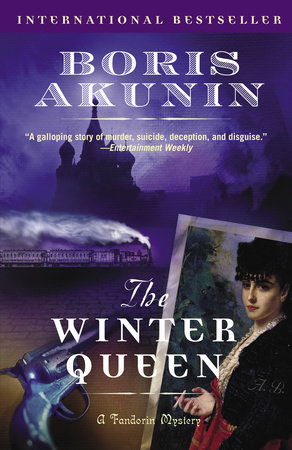
The cover is very interesting and does a good job of capturing the style of the book with its mysterious graphic design and images of a gun, train, silhouette of St. Basil's cathedral, and painted portrait of a beautiful lady, all of which show up in the book. This cover is what drew me to buy the book, especially since I like purple.

Score: 4 out of 5 stars
Read in: earlyish January
From: thrift store
Format: paperback
Status: tentatively holding on, but may give away in the future because I have limited space available

Tuesday, July 18, 2017

April-June 2017 books

The first book I read in April was Ella Minnow Pea: A progressively lipogrammatic epistolary fable by Mark Dunn. This is one of the most unique books I’ve ever read because as the book goes on, it keeps using words with fewer and fewer letters. It’s also a fable with a moral in it. In a fictitious? island off the coast of South Carolina, a charmingly retro town adores its statue of a hometown boy made good: the guy who invented the phrase “the quick brown fox jumps over the lazy dog”, which is mounted on his statue. When the letters begin to fall off the decaying statue, the superstitious (or enterprising?) town elders decide it is a message from beyond the grave that the entire island must give up using that letter from the alphabet. You can imagine what happens when more and more letters keep dropping from the statue, and the faster they fall, the more outrageous and rapacious the demands on the townspeople become. This book made me angry because I could see a clear parallel between the “devout” town elders, who really just wanted a reason to take others’ houses and property, and current events. Clever, creative, sweet and mirroring our times: highly recommended. 4/5

Ellen White’s World: A fascinating look at the times in which she lived is the third book from George R. Knight’s Ellen White series. It’s basically a sweeping overview of the nineteenth century’s religious and cultural aspects, with a few EGW quotes thrown in to tie it to the Adventist prophet and writer. I had to read this for a class and found this book interesting, but I thought Ellen White’s World should have included more on the prophet herself and not kept to such an insanely short page length. 3.9/5

Bee: The Princess of the Dwarfs by Anatole France is a classic old-fashioned fairytale about a princess and her cousin/betrothed who, as children, wander from home and get kidnapped by dwarves and nixies, respectively. It was a nice story but very short, and I felt like it could have been fleshed out more. The ending was also kind of meh because there wasn’t any sort of climactic battle; the kids end up being freed by the king of the dwarfs because he loves Honeybee. Yes, that’s her nickname; not sure why they didn’t just put Honeybee instead of Bee in the title. I mostly liked this anyway. This was a Nook ebook. 3.4/5

Another Nook ebook that I read was A Sicilian Romance by Ann Radcliffe, which was a Gothic Romance. Secret passageways and tunnels below a castle, possible ghosts, tons of chases, heroine is constantly fainting and needing to be rescued, several faked deaths, a corrupt abbot, a band of thieves, caves, forced marriages and true love. A fun trip. 3/5

I guess I was in the mood for Gothic novels since after that I read Carmilla by J. Sheridan Le Fanu. Carmilla, which has been adapted into a YouTube video series, is the OG lesbian vampire who preys on pretty young women, hilariously changing her name to another anagram as the decades pass (Marcilla etc.). As with most if not all classic vampire novels, it ends with the hunting and elimination of the vampire threat. Even going in with full knowledge of what friendships between girls were like in Victorian times, this was super gay. It ended pretty abruptly (I guess a lot of novels from this period do), but I liked it anyway; it was pretty funny. 3.5/5

Technically I finished this book in July but I mostly read it in June, so I’m going to include it in here anyway. Torn: Rescuing the Gospel from the Gays-v.s.-Christians Debate by Justin Lee is an excellent book about how we should view and treat gay Christians and gay people in general, and how our church should change its view of homosexuality and how it treats those in the LGBT+ spectrum if it wants to repair relationships rather than cause pain. This was excellent; highly recommended. I honestly feel like every Christian should read this regardless of their orientation and opinion. 4.9/5

Friday, August 5, 2011

The Rivals and Further Rivals of Sherlock Holmes

I read two books that are collections of short mystery and detective stories, written and set around the same time as Sherlock Holmes. They ranged from the mediocre (there were some where the mystery was solved but the person got off free, or where the ending was just "...oh." I hate that) to the awesome (a blind detective BAMF is put in a hostage situation because the villains know he's the only one who can stop them. He cuts the electrical light's cord, plunging the room in darkness and putting them all on equal footing. He has the drop on them due to his enhanced hearing and threatens to shoot anyone who moves. They all sit there in the darkness until his friends arrive to save him. The whole time he didn't have a gun). My favorite ones where the ones with lady detectives, because usually other people (men, mostly. These stories tend to be quite male-centric as a matter of course) underestimate them and they come out and solve the case like a boss. I think I liked the Sherlock Holmes stories more because Conan Doyle is better about explaining how he figured out the case. It drives me crazy when no explanations are given. The writing varied due to the different authors, but most of it was about as good as Conan Doyle's. I think the popularity of Sherlock Holmes is due mainly to his singular character. He's just so memorable and iconic. You think of mysteries and detectives and you think of Sherlock Holmes and his friend Watson.