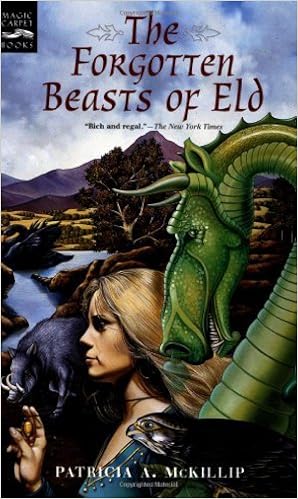
trigger warnings for mentions of rape, kidnapping, emotional abuse, manipulation
I have read a few books by Patricia A. McKillip a while back and really liked them, so I was excited to scoop this one up. I love fantasy stories and mythological beasts.
Amazon summary:
Young Sybel, the heiress of powerful wizards, needs the company of no-one outside her gates. In her exquisite stone mansion, she is attended by exotic, magical beasts: Riddle-master Cyrin the boar; the treasure-starved dragon Gyld; Gules the Lyon, tawny master of the Southern Deserts; Ter, the fiercely vengeful falcon; Moriah, feline Lady of the Night. Sybel only lacks the exquisite and mysterious Liralen, which continues to elude her most powerful enchantments.
But Sybel's solitude is to be shattered when a desperate soldier arrives bearing a mysterious child. Soon Sybel will discover that the world of men is full of love, deceit, and the temptations of vast power.
This was, per usual, very well written, with subtle characterization and a mysterious feel throughout the story. The main storyline was very "ice princess learns to feel", which isn't my favorite, but was handled well by McKillip. Too often, books kind of punish or scold female characters who love isolation, because women are supposed to have families or be available to men, blah blah blah. I find this mentality especially stupid because the author wrote the female character that way! Anyway, there was that whole "now that I love someone I'm afraid to lose them/they will get injured etc., it was better before I loved anyone" thing, which is a little par for the course at this point. Like, didn't she love the beasts? They loved her, as evidenced by the twist at the end of the book (it made me emosh). Didn't she love her father?
Also, as soon as Sybel gets the baby, a witch pops up out of nowhere to take care of him/teach Sybel how to take care of him. Was she there when Sybel was a baby? Did she take care of her as a baby? Why isn't she mentioned in Sybel's origin story? It was kind of weird to have such an interesting and important character be such an afterthought.
What I found the most interesting (besides the beasts, of course) was the idea of fear turning you into a monster. Fear keeps you from truly loving someone and makes you do horrible things. Fear and control go hand in hand. SPOILERS FOR THE REST OF THIS POST The king wanted Sybel but was afraid of her and her powers, so he got a more powerful wizard to force her to come to him so he could wipe her personality and powers and leave her a smiling shell for the wizard to use however he wanted. She gets away thanks to the fear monster (literalism!). Then, when Sybel is married to the soldier, she doesn't want him to think badly of her wanting to take revenge against the king, so she wipes his memory of finding her plotting with the opposing kingdom's rulers.
However, it should be noted that it's not like Sybel knew any better. She was born because her father the wizard magically kidnapped a princess that wandered too close to his castle and raped her. She died while giving birth to Sybel. I don't remember how the wizard dad was born, but it was probably something similar. Let's be real: what the king planned to do to Sybel was way worse than what she did to her husband. Like, it wasn't great, but manipulation of memories isn't complete personhood destruction and rape. (Also, did the king really think her nephew [the baby grown up] wouldn't notice that his aunt was a shell of herself? Like honestly, how stupid.)
Also, she had absolutely zero qualms about keeping sentient magical creatures in her castle, probably because it was her father and grandfather who kept them in the first place and taught her it was okay. Like, I would feel bad keeping regular wild animals. Wild animals should be free; sentient magical animals, doubly so. It's basically like keeping people imprisoned. I guess that's why she let them go in the end; she understood about trying to control people you profess to love.
I think the cover on my copy is decent, but I like this one better. Sybel's hair color is more accurate, and the animals look realistic and mysterious rather than cartoony.
Score: 4 out of 5 stars
Read in: early November
From: thrift store probably
Format: paperback
Status: keeping probably
Monday, December 10, 2018
Thursday, December 6, 2018
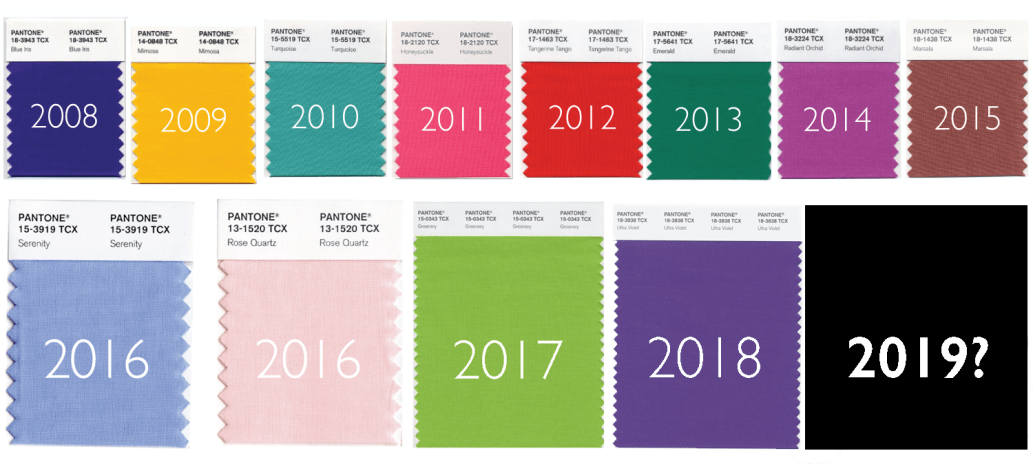
Pantone's Colors of the Year 2008-2019, ranked
This is extremely subjective.
- Ultra Violet, 2018: sick name, gorgeous color, evocative of royalty, not too bright or too blue/red, perfect. Yes, this is my favorite color; what about it?
- Radiant Orchid, 2014: bright, cheerful, the color of the most expensive and exotic flowers, unfussy, unprecious, not overused, my second-favorite color.
- Blue Iris, 2008: The color in the header image does not reflect this shade at all. It's a purplish blue, like a dark periwinkle. Literally the color of blue irises, one of my favorite flowers.
- Turquoise, 2010: such a fun, bright cheerful color. So pleasant and versatile. Hard not to feel better when you look at it.
- Emerald, 2013: rich, opulent green. Bold but replenishing, deep yet uplifting . Use it for jungle, forest, tribal, Victorian, just about any type of look.
- Living Coral, 2019: maybe it's the influence of the #rainbowlife Instagrammers I follow, but I actually like this color. Bright, summery and sunny but girly and fun rather than an eyesore.
- Tangerine Tango, 2012: girl, this is red. I just googled the shade name and the actual Tangerine Tango is like Living Coral but with more red. It's nice, whatever.
- Greenery, 2017: this is fine. The curtains my father chose for the bedroom I sleep in when I visit my parents is this color. Anyone suddenly craving fresh Granny Smith apples?
- Serenity, 2016: aka the "It's a Boy!" color. snooze (although I guess that's the point)
- Rose Quartz, 2016: wait, they chose both these colors for 2016? Baby blue AND baby pink? Did they not see the unfortunate baby shower implications? Like it is a pretty color, and millennial pink was/is a huge thing, but still. Pick a side!
- Marsala, 2015: this is actually the prettiest brown I've ever seen, but it's nearly invisible next to all these other colors. The color in the image above doesn't represent it well at all.
- Honeysuckle, 2011: it's Barbie, bitch. I googled it and while some varieties of honeysuckle are bright pink, none are as bright as this color (I think).
- Mimosa, 2009: all I see is mustard, and mustard is gross.
Thursday, November 29, 2018
If my father's wildest dreams came true...
My youngest brother and his fiance would both be doctors in our hometown's
medical centers, get married,* settle down in a very nice house five minutes or less from my parents' house, and give him grandchildren.
My sister and her husband would leave New York City and move back to our hometown, get a job at the local medical center's rehab department (my sister) and financial department (my brother-in-law), live in a nice house five minutes or less from my parents' house, and give him grandchildren.
My other brother and his wife would find jobs in the IE branch** of a big tech company such as Apple (my brother) and local medical center's pharmacy (my sister-in-law), move into a very nice house five minutes or less from my parents' house, and give him grandchildren.
I would allow my father to set me up with a nice young man he met at the gym or Sabbath school, and we would get married and move into a charming house in our hometown five minutes or less from my parents' house, where I would work for the local university or public library (and my husband would probably be a doctor at the local medical center), and give him grandchildren.
We would all be very entangled in each other's lives, have a weekly dinner, and go on vacations together like the Modern Family family.
*this is already happening obviously
**does not exist
My sister and her husband would leave New York City and move back to our hometown, get a job at the local medical center's rehab department (my sister) and financial department (my brother-in-law), live in a nice house five minutes or less from my parents' house, and give him grandchildren.
My other brother and his wife would find jobs in the IE branch** of a big tech company such as Apple (my brother) and local medical center's pharmacy (my sister-in-law), move into a very nice house five minutes or less from my parents' house, and give him grandchildren.
I would allow my father to set me up with a nice young man he met at the gym or Sabbath school, and we would get married and move into a charming house in our hometown five minutes or less from my parents' house, where I would work for the local university or public library (and my husband would probably be a doctor at the local medical center), and give him grandchildren.
We would all be very entangled in each other's lives, have a weekly dinner, and go on vacations together like the Modern Family family.
*this is already happening obviously
**does not exist
Wednesday, November 14, 2018
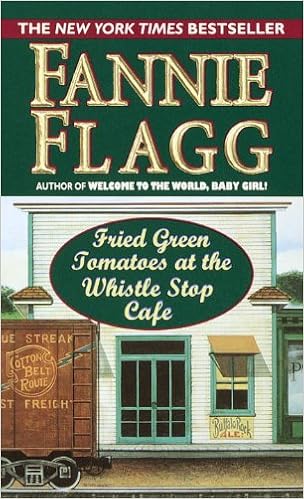
Book review: Fried Green Tomatoes at the Whistle Stop Cafe by Fannie Flagg
trigger warnings for mentions of domestic violence, rape, and racism
I got Fried Green Tomatoes at the Whistle Stop Cafe during my thrift store haul a few months ago. I had read something online that said it was a great book about women's friendship, or something to that effect. I had mostly enjoyed the movie Steel Magnolias, so I thought I'd give this a try.
Well, it was different. FGTatWSC has two main storylines. The primary one is set in modern times (the 1980s) and is about Evelyn, a depressed middle-aged woman with an unsatisfying life, becoming friends with an elderly woman, Mrs. Threadgoode, at her mother-in-law's rest home, and this friendship gives her a new outlook on life. Mrs. Threadgoode is originally from a small Alabama town by the train tracks called Whistle Stop, and she tells Evelyn all about the town, its varied and sometimes kooky inhabitants, and the Whistle Stop Cafe. Her stories make up the second storyline, although we also get some omniscient narrating going on, as the storyline contains things we know Mrs. Threadgoode couldn't know.
Evelyn and Mrs. Threadgoode are the two main characters of the modern-day storyline, and the Whistle Stop Cafe's proprietresses, Idgie and Ruth, are the two main characters of the Whistle Stop storyline, which takes place from the 1910s to the 1950s or so. Idgie, who grew up with Mrs. Threadgoode, is a tomboy (read: butch lesbian) who decides to never wear dresses again at age 9 and falls in love with older, new to town Ruth as a teenager. Ruth, afraid to be gay/sin, leaves Whistle Stop and goes back to her fiance and marries him, breaking Idgie's heart in the process. The husband turns out to be a sociopath serial rapist and seducer who domestically abuses and rapes her, so she leaves him and gets back together with Idgie, and they open up the Whistle Stop Cafe.
The Cafe cook is Idgie's old nanny, Sipsie, who is African American. Her family is described to us just as much if not more, in some ways, than the white families in Whistle Stop. Since this the American Southeast in the early 20th century, there is of course a ton of racism. While I appreciated that Ms. Flagg fleshed out the African American characters instead of leaving them to be invisible background characters, which often happens with domestic help in this era, I could have done without being told how some of them died, and many of them experienced horrible yet unsurprising racism. Many white townspeople didn't like how Idgie and Ruth fed hobos, but they really got mad when they fed Black people (not even in the cafe but out the back door), and Idgie and Ruth had to stand up to the KKK a few times. There was some parsing of different attitudes held by Black people as the Civil Rights Movement progressed, such as looking down on their elders who had worked for white people.
All in all, this was a very interesting account of Southern small-town life and a lesbian love story. I was surprised by how many townspeople knew about Idgie and Ruth's real relationship and were fine with it (the others just considered them good friends). While I didn't talk about Evelyn much, I really identified with her despair and rage, including how she often imagined herself as a superhero, killing all the bad guys in the world. The eighties truly were similar to today, politically. I liked that she found the confidence to take charge of her life. There is also a riveting murder mystery with a twist ending, and recipes of some of the foods mentioned! I recommend this book if you can handle sad stories and everything that goes along with stories set in the American Southeast in the 20th century.
Score: 4 out of 5 stars
Read in: late October-early November
From: thrift store
Format: paperback
Status: giving away
I got Fried Green Tomatoes at the Whistle Stop Cafe during my thrift store haul a few months ago. I had read something online that said it was a great book about women's friendship, or something to that effect. I had mostly enjoyed the movie Steel Magnolias, so I thought I'd give this a try.
Well, it was different. FGTatWSC has two main storylines. The primary one is set in modern times (the 1980s) and is about Evelyn, a depressed middle-aged woman with an unsatisfying life, becoming friends with an elderly woman, Mrs. Threadgoode, at her mother-in-law's rest home, and this friendship gives her a new outlook on life. Mrs. Threadgoode is originally from a small Alabama town by the train tracks called Whistle Stop, and she tells Evelyn all about the town, its varied and sometimes kooky inhabitants, and the Whistle Stop Cafe. Her stories make up the second storyline, although we also get some omniscient narrating going on, as the storyline contains things we know Mrs. Threadgoode couldn't know.
Evelyn and Mrs. Threadgoode are the two main characters of the modern-day storyline, and the Whistle Stop Cafe's proprietresses, Idgie and Ruth, are the two main characters of the Whistle Stop storyline, which takes place from the 1910s to the 1950s or so. Idgie, who grew up with Mrs. Threadgoode, is a tomboy (read: butch lesbian) who decides to never wear dresses again at age 9 and falls in love with older, new to town Ruth as a teenager. Ruth, afraid to be gay/sin, leaves Whistle Stop and goes back to her fiance and marries him, breaking Idgie's heart in the process. The husband turns out to be a sociopath serial rapist and seducer who domestically abuses and rapes her, so she leaves him and gets back together with Idgie, and they open up the Whistle Stop Cafe.
The Cafe cook is Idgie's old nanny, Sipsie, who is African American. Her family is described to us just as much if not more, in some ways, than the white families in Whistle Stop. Since this the American Southeast in the early 20th century, there is of course a ton of racism. While I appreciated that Ms. Flagg fleshed out the African American characters instead of leaving them to be invisible background characters, which often happens with domestic help in this era, I could have done without being told how some of them died, and many of them experienced horrible yet unsurprising racism. Many white townspeople didn't like how Idgie and Ruth fed hobos, but they really got mad when they fed Black people (not even in the cafe but out the back door), and Idgie and Ruth had to stand up to the KKK a few times. There was some parsing of different attitudes held by Black people as the Civil Rights Movement progressed, such as looking down on their elders who had worked for white people.
All in all, this was a very interesting account of Southern small-town life and a lesbian love story. I was surprised by how many townspeople knew about Idgie and Ruth's real relationship and were fine with it (the others just considered them good friends). While I didn't talk about Evelyn much, I really identified with her despair and rage, including how she often imagined herself as a superhero, killing all the bad guys in the world. The eighties truly were similar to today, politically. I liked that she found the confidence to take charge of her life. There is also a riveting murder mystery with a twist ending, and recipes of some of the foods mentioned! I recommend this book if you can handle sad stories and everything that goes along with stories set in the American Southeast in the 20th century.
Score: 4 out of 5 stars
Read in: late October-early November
From: thrift store
Format: paperback
Status: giving away
Wednesday, November 7, 2018
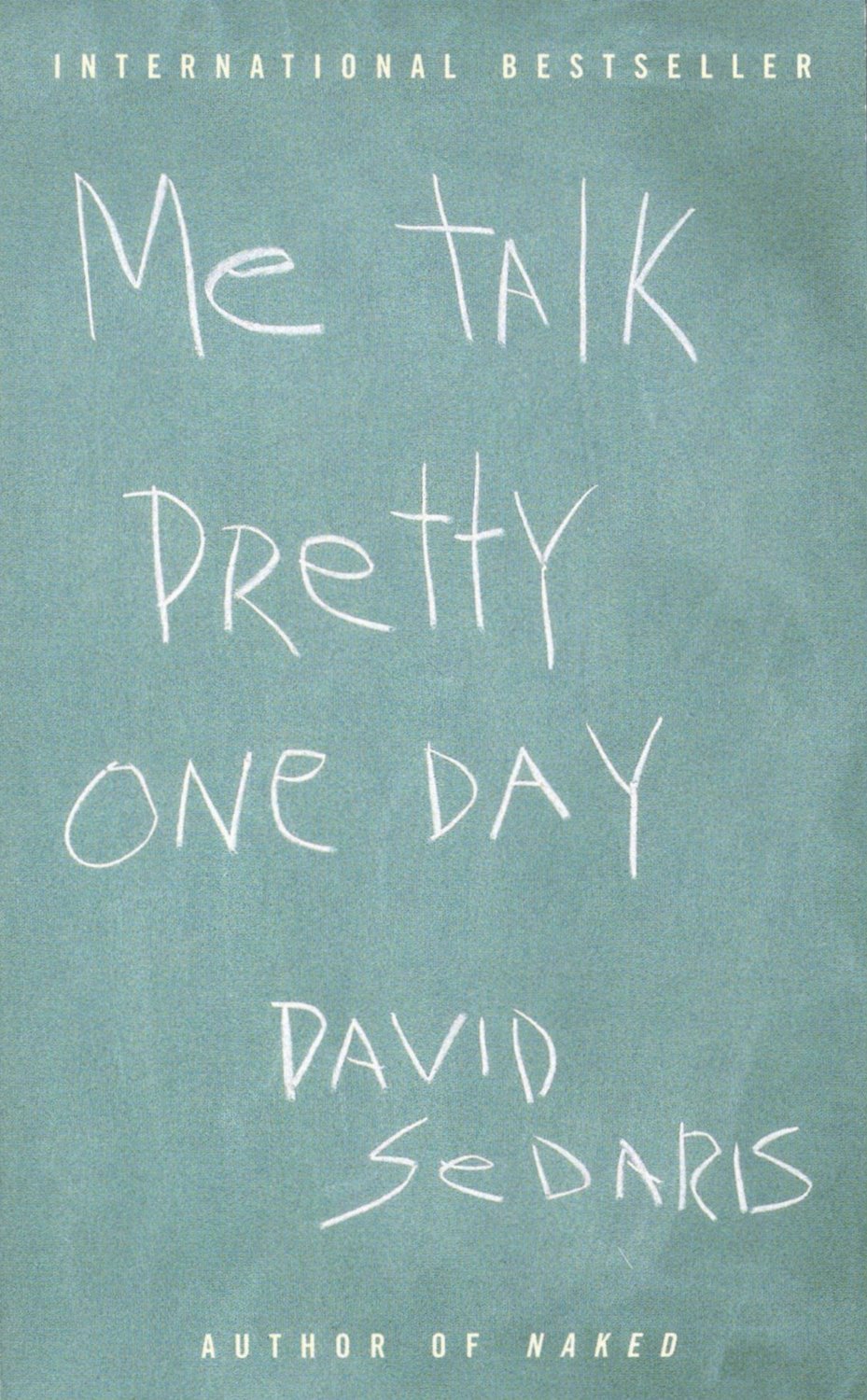
Book review: Me Talk Pretty One Day by David Sedaris
I have owned Me Talk Pretty One Day (MTP1D) for several years, ever since my creative writing teacher in college made us read from it for class. I've since read two other of Sedaris's books, and while he's a talented writer, I no longer find him as funny as I used to. Like I said in a previous review, I just have less tolerance now for what older white cis men have to say about race, etc. His essays are generally rather amusing, but there is a lot there that would be considered cringy rather than funny, in my opinion. I think his essay about being addicted to drugs would be a useful one for teachers of college and possibly even high school students; reading about a detoxing and desperate Sedaris inhaling every particle on his floor in case he had dropped some drugs is enough to take away their glamour and danger.
My favorite essay has to be about how his father was obsessed with his daughters being thin and beautiful. It is of course horrifying and depressing, considering at least two Sedaris sisters became a drug addict and developed an eating disorder, respectively, but it's also kind of comical to read. Sedaris had this great, wry line about how he, the son, could have been eating mayonnaise out of the container with a serving spoon and his father didn't care, but if one of the girls gained a pound, the father acted like her life was ending and harassed her into dieting. It sounds pretty depressing but it was hilarious to read how Amy, who today is a famous actor, got her own back.
The title, in case you are wondering, comes from an essay where Sedaris shares what it was like to learn French in a beginner's class with other expats from around the world. Anyway, MTP1D is worth a read, but check it out from the library.
Score: 3.5 out of 5 stars
Read in: early September
From: thrift store? don't remember
Format: paperback
Status: giving away
My favorite essay has to be about how his father was obsessed with his daughters being thin and beautiful. It is of course horrifying and depressing, considering at least two Sedaris sisters became a drug addict and developed an eating disorder, respectively, but it's also kind of comical to read. Sedaris had this great, wry line about how he, the son, could have been eating mayonnaise out of the container with a serving spoon and his father didn't care, but if one of the girls gained a pound, the father acted like her life was ending and harassed her into dieting. It sounds pretty depressing but it was hilarious to read how Amy, who today is a famous actor, got her own back.
The title, in case you are wondering, comes from an essay where Sedaris shares what it was like to learn French in a beginner's class with other expats from around the world. Anyway, MTP1D is worth a read, but check it out from the library.
Score: 3.5 out of 5 stars
Read in: early September
From: thrift store? don't remember
Format: paperback
Status: giving away
Monday, October 29, 2018
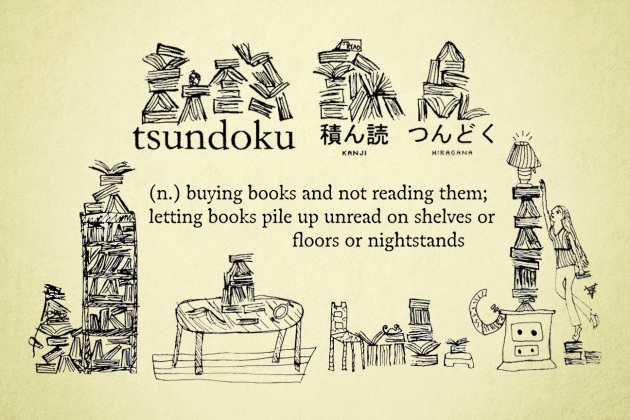
Reasons why I don't finish/have a hard time finishing/straight up don't read books
- the book is really boring
- the book is really dense and academic and my brain has acclimated to online video streaming and social media so it's not what it once was
- I have a mental block about reading for some reason/reading dry spell
- I don't have time; I'm too busy
- I hate the book
- lack of energy
- previous book hangover
- the cover is weird/off-putting
- the book is too intimidating
- I don't read multiple books at a time so I feel like I must finish the book I'm on even though I don't feel like reading it, so I read nothing
- it's a library book that I have to return so I never finish it
- I have to spend my ref desk time slots doing homework or helping patrons instead of reading
- when at home or on weekends, I do chores, run errands, or binge Netflix (or do the BookRiot #riotgrams challenge), so I have no time/energy to read
- I've hyped up the book in my mind so much I'm afraid to read it
- I'm not in a proper headspace for this book. or that one. or that-
- I think this book is going to be sad/scary and I'm too anxious to read it
- I don't think I'm mentally prepared for this book right now
- this book sounds too pretentious or frustrating
- I bought this book ages ago and and still haven't read it so I owe it the bare minimum of leaving it on my shelf to read someday
- I have a book/some books from a series and don't have all of them
- I have a series but don't know which one is the first
- I have a series but don't know if I have gaps in it
- I loved this book in college/high school/childhood but I'm afraid if I reread it it won't be the same
- some smart friend/s recommended this book to me and I don't want to let them down (even though we never talk any more)
- I have to read this book in order to decide whether to keep it and that's too much pressure
- what if this book disappoints me
- this book has themes I know are going to be upsetting/triggering/angry-making to me
- there are knicknacks on the shelf in front of the book and it's too much work to move them
- seeing my dusty bookshelves reminds me that I need to clean my house and that depresses me
- this book is going to be very simple and fun and easy to read, so I'll read it later
Monday, October 15, 2018
App game review: Garfield Snack Time
As a nearly life-long Garfield fan, I saw the game "Garfield Snack Time" (GST) and decided to play it. It's a typical match-3-or-more-items game, with bigger points for more items matched, and possible boosters or helpful items. Each game has a specific goal: get lasagne to the basket at the bottom of the field, get a certain number of points, collect a certain amount of each of the items, etc. There is a daily challenge that awards you with one coin or more, and the game urges you to connect your Facebook account or buy more coins and boosters with real money at every turn. Watching short video ads gives you 'free' turns or rockets. The app company also constantly hawks its other games, which is annoying.
The game is bright and colorful, with everything animated in a Jim Davis style. It's cute and very addictive. Everything is food-based, with the matchable items being food: blue popsicles, green fast-food soda cups, pink lollipops, red containers of french fries, and yellow pizza slices. Personally, instead of lollipops, they should have had cupcakes, as that is a food item I could see Garfield more readily eating.
Something else that annoys me is that whenever you fail to make your game's goal, GST does not give you the option of watching an ad video in order to get five (or even one) more turns, the way many other similar apps do. Instead, you have to pay 70 coins to get five turns, or 120 coins to get five turns and 3 boosters. GST also does not set off your remaining rockets and other boosters after you run out of turns, which I think is incredibly unfair.
Besides the aforementioned turn limits, there are stopwatch "bombs" that will go off in a certain amount of turns, evil anthropomorphic onions that create rings that block areas of the board and mugs of coffee that cover the items in a java lock, requiring you to match the item twice before it disappears. I hate this. Garfield LOVES coffee in the comics, so the java mugs should be a power-up, not a deterrent! The ad companies are very sneaky and often format their ad like an actual video, causing it to play sound (often loudly) despite my phone being on silent. There is a special place in hell for them.
Anyway, which it's not being an unfair, frustrating and unsolvable pain in the butt, this game is fun, and I more or less recommend it. 3.5/5 stars
Friday, October 5, 2018
Classic literature books reimagined as eyeshadow palettes: The Pilgrim's Progress by John Bunyan
The Pilgrim's Progress eyeshadow palette
Christian - matte neutral tan
The Great Burden - matte medium brown
The Slough of Despond - matte black
Hellfire - glittery/shimmery bright orangey red
New Garments - matte pure white
The Armor of God - metallic silver
Vanity Fair - glittery hot pink
The Delectable Mountains - satin grass green
The River of Death - shimmery deep blue
Mercy - satin pale pink
Great Heart - metallic royal purple
The Celestial City - shimmery white with gold microglitter
4 mattes, 4 glitters/shimmers, 2 metallics, 2 satins, a lot of Christianity
The palette itself would look like the original book (see above-right image) on the outside, and when you open it, it looks like a map of the story, with the shade names in the corresponding places. How cool would that be??
Hey Storybook Cosmetics, call me!
Subscribe to:
Posts (Atom)
-
Previously: the first post in this series I mentioned previously how I collect multiple editions of The Chronicles of Narnia that have diffe...
-
(opinames. namepinions. opinameions) source Names should (depending on your values) hit that sweet spot where your child's name...
-
The first book I read and finished this year was Debating Disney: Pedagogical Perspectives on Commercial Cinema , which was a series of essa...